
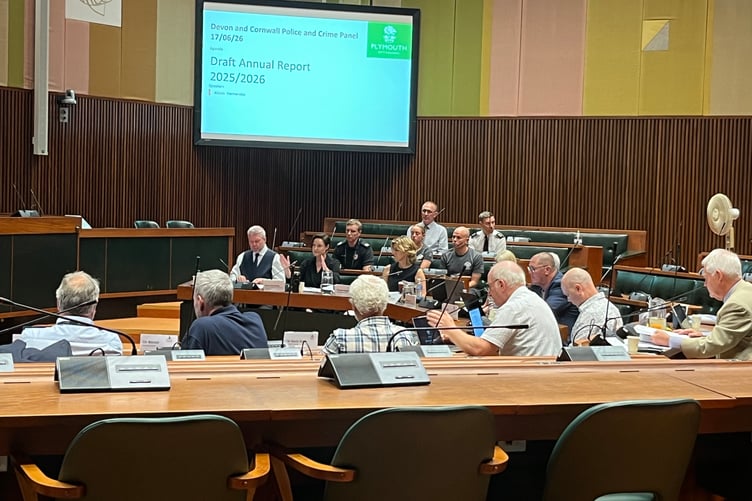
Women and children are being let down because investigations into domestic abuse are not good enough, a police and crime panel has heard.
Police and crime commissioner Alison Hernandez described the situation as “woeful” at a meeting of the two counties panel on Friday in Plymouth.
The issue was raised following the latest PEEL (Police Effectiveness, Efficiency and Legitimacy) inspection by His Majesty’s Inspectorate of Constabulary and Fire and Rescue (HMICFRS), which highlighted the force as inadequate at investigating crime and safeguarding vulnerable people.
Devon and Cornwall Police says it is working with partners to deliver “improvements at pace”.
Panel member Cllr Chris Penberthy (Lab, St Peter and the Waterfront), Plymouth City Council cabinet member for community safety and safeguarding, said there was a “disproportionately high” level of domestic abuse investigations in the force and Plymouth was a hotspot.
“Women and children are being let down and that can’t continue.”
He pressed the commissioner on what the police were doing to get on top of this, as support services in the city were good, including safe spaces run by the Trevi charity, and male perpetrator schemes had been operating in the city for decades with support from the council.
He said violence against women and girls was “a men’s issue”.
“One of the ways we get men to take responsibility is to see consequences, and that is most visible when they are standing in a dock in a court and facing stuff.
“Women need to know they are being protected by the police, what are the police doing?” he said.




“I’ll tell you right now… it is woeful,” said the commissioner. “What’s woeful is women getting blamed for the abuse from men. They are losing their children and being blamed for the abuse, especially if drugs or alcohol are involved.
“I have met many victims who have suffered, and at the end of the day women end up losing the child rather than the man being stopped.
“I am absolutely fed up of it, fed up of hearing it and fed up of seeing it.
“We have got to stop the victim blaming, and I’m afraid it is rife in society.
“This is a major issue nationally but Devon and Cornwall’s investigations are not good enough.”
Miss Hernandez said she was trying to work with communities to try and change things with a Male Ally Network (MAN), a pilot project being set up in Cornwall to help challenge the behaviour of men and start supporting women, which would spread into Plymouth.
The PEEL report said there was a queue of more than 8,000 domestic abuse public protection notices waiting for review by Devon and Cornwall police dating from October to December 2025.
These notices are issued to a perpetrator to provide immediate protection to victims of all forms of domestic abuse.
The commissioner said there were too many cases sitting in “medium risk” as officers were afraid to put them in “low risk” and she hoped the move towards the CARA (cautioning and relationship abuse) model would help.
CARA supports offenders in understanding what domestic abuse is, the harm their actions have caused, the impact this has had on their partners, children and relationships, and how to make different choices going forward and prevent these harmful behaviours from becoming more entrenched.
The PEEL report recognised that the force had made improvements in some areas since the last inspection, particularly in how it responds to calls for service from the public.
His Majesty’s Inspector of Constabulary Kathryn Stone said she was “satisfied” with some aspects of the performance of the police force in keeping people safe, reducing crime and providing an effective service to victims.
But she said: “It is disappointing that the force still hasn’t made enough progress on a previous area for improvement about how it manages medium-risk domestic abuse cases. This is a concern the force needs to address quickly.”
Detective Superintendent Nicky Seager said: “Safeguarding vulnerable adults and children is a top priority for Devon & Cornwall Police. While inspectors identified inconsistencies in the quality of some Domestic Abuse Public Protection Notifications (PPNs), this does not mean safeguarding was absent. We have robust and effective arrangements in place to protect victims and those at risk of harm, and we recognise that high-quality PPNs are a vital part of that process.”
She said there was increasing investment in the force’s central safeguarding function and further developing technology to support the prioritisation of PPNs, enabling more timely and effective secondary reviews.
“This enhanced capacity helps ensure that risks identified by frontline officers and partner agencies are fully understood, that critical information is shared appropriately, and that safeguarding decisions are made quickly to protect those most vulnerable.
“The 8,000 PPNs referenced in the HMICFRS report were subject to an initial risk assessment and subsequent policing response at the time they were received. We have applied a technological assessment to those and have identified a proportion that will be subject to a further secondary risk assessment. At this time, we have not identified any missed opportunities for associated safeguarding activity and referrals.”
She added that there had been additional training for frontline officers and the CARA programme continued to be used for domestic abuse offenders who had received a conditional caution and had no recent convictions for violence.
“We are working closely with the police and crime commissioner, HMICFRS and the College of Policing to deliver improvements at pace and we remain committed to making sustainable changes that strengthen our service and achieve better outcomes for victims of domestic abuse,” she said.
“We are confident that, through the dedication of our officers, staff and partners and the actions already underway, we will continue to improve and provide the high standard of safeguarding that our communities rightly expect.”
Comments
We've recently changed our login process. If you have an account for commenting, you will need to re-register on the login window.
This article has no comments yet. Be the first to leave a comment.