
.jpeg?trim=0,0,3,0&width=752&height=628&crop=752:628)
When Chloe Rooker, 27, discovered she was pregnant in 2022, she had no reason to think her first experience of motherhood would be anything other than joyful.
She had already found out she was having a girl and chosen the name Daisy when, at her 20-week anomaly scan, concerns were raised about her unborn baby’s brain.
Further investigations confirmed ventriculomegaly – an abnormal accumulation of fluid in the brain – alongside duplex kidneys. An amniocentesis was carried out, with the results sent to Great Ormond Street Hospital for further genetic testing.
As the pregnancy progressed, the amount of fluid in Daisy’s brain continued to increase.
Chloe was warned that her baby’s chances of reaching full term were diminishing and that, if she survived, she could be born in severe pain with little to no quality of life.
Doctors explained the possibility of a late termination.
As for any expectant parent, Chloe did not want to make that decision – but she also did not want to bring a child into the world if that meant Daisy would suffer.
.jpeg?trim=0,14,0,13&width=752&height=501&crop=752:501)
For 15 weeks, Chloe lived with the possibility that the baby she had spent her life dreaming of might never survive.
What follows is entirely Chloe Rooker’s own writing:


“I have always felt ready to be a mummy, so when I discovered I was pregnant at 23, I felt it was always meant for me. I found out she was a girl and named her in an early private scan, but during the 20-week anomaly scan, I have a vivid memory of the ultrasound technician silently, desperately trying to get a good view of Daisy’s head to the point where her hand was shaking. I don’t have any memory of what she said to me after that, but I do remember asking to go out the back way, so I didn’t scare any of the other expectant mothers with this primal reaction that came spilling out of me. People dropping to the ground in TV tragedies always seemed so over-dramatic before, but when I got home to my mum, tears rolling down my face, I exploded with “they’re saying she might have brain damage” and collapsed. All the breath in my body and strength in my legs was stripped away from me in that moment.
An urgent referral to the neonatal consultant the next morning meant a full body scan of the baby, confirming ventriculomegaly and duplex kidneys. I had an amniocentesis that day, and because there were two physiological abnormalities, they sent the amniotic fluid for further genetic testing at Great Ormond Street. I distinctly remember the geneticist phoning me and explaining that if they don’t find anything, it doesn’t mean she doesn’t have a genetic condition, because there are so many left undiscovered. Heads I lose, tails I lose. All hope fell away at this point.
A 15-week roller coaster of emotions followed. The amount of fluid in her ventricles was growing in every bi-weekly scan and MRI. Then the day came when they made me understand how bad this could get. They said that the likelihood of her making it to term was reducing daily, and if she did make it, she would have been born in a lot of pain, with little to no quality of life. They explained the procedure for a late termination, thoughts of which still haunt me to this day.
Then, at the 35-week scan, everything changed. It hadn’t developed at the previous scan, and at the next it had started to reduce. I was discharged until she was born 3 weeks later, and she was transferred to the children’s ward for a scan an hour after she was born. They expressed their shock at her completely ordinary brain. I almost felt an imposter getting to hold this little baby in my arms after so long thinking I wouldn’t get to hold her.
A year of invasive and traumatising tests are now behind us, and nearly three years later, my little miracle girl is thriving. The most beautiful, funny, clever little thing.
There is so much more to this story, but I write this article in the hope of spreading hope and helping others who have experienced similar stress and heartache.
If any others want to reach out or share their story, please email [email protected]”
The reality of how bleak those 15 weeks became is something Chloe says is difficult to explain. She gradually became more and more depressed and reclusive, even to family.
By around 30 weeks, Chloe had lost almost all hope. She began thinking about Daisy’s funeral and even considered what she might do with her ashes.
The possibility of termination was equally agonising.
“I didn’t want to bring someone into the world and just have them in pain just because I want to meet them,” she said.
It was, she describes, like being “tortured for 15 weeks and then being released”.
There was, however, one moment during that period which Chloe now looks back on with a smile.
Following the devastating 20-week scan, she spoke to Daisy while travelling to an urgent referral appointment, telling her: “You tell them, Daisy, you say go away, I’m fine.”
During the scan, the consultant suddenly laughed.
Daisy appeared to be holding up two fingers – a gesture which the consultant joked she had never seen from a baby before.
Later in the same appointment, Daisy appeared to give a thumbs-up.
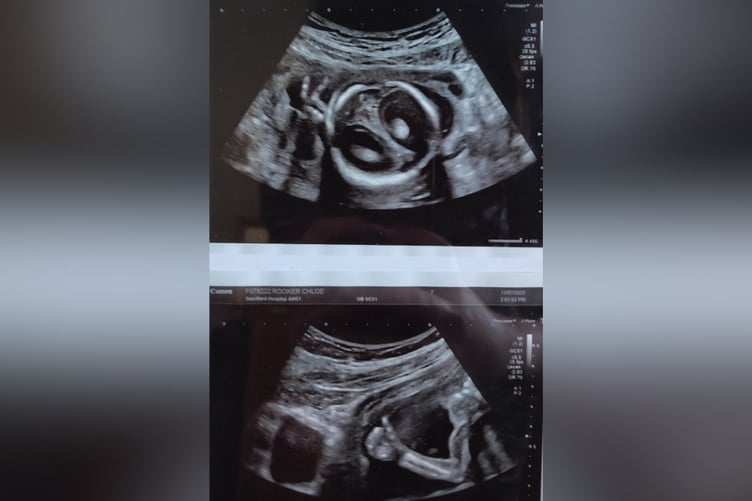
At the time, however, the humour was almost impossible to see. Chloe was still facing the possibility that her daughter might not survive.
Today, Daisy is three.
She is polite, funny, kind and incredibly eloquent. She loves reading and playing, has lots of friends and is regularly praised by her teachers.
She is also brave. Daisy loves swimming in the sea and is more than happy to jump into the waves - regardless of how choppy they are.
Perhaps the strangest part of the story is reconciling the lively three-year-old bounding around a play park with the baby a mother once believed she’d never hold.
The experience has understandably affected Chloe. She has spoken of flashbacks and anxiety following the pregnancy and the subsequent medical investigations. She says she struggled to find appropriate professional support for her particular experience.
Now she hopes something positive can come from what happened.
Chloe has launched the Instagram account @cr_sharecommunity, with the aim of creating a supportive space for parents and families who have experienced similar prenatal crises.
She wants it to be a place where people can find others who understand what they are going through, share their experiences and, where necessary, be signposted towards professional support.
Her message to other parents facing frightening news during pregnancy is simple: they are not alone, and there can be hope.
For Chloe, the greatest reminder of that hope is Daisy herself – a little girl who was once the subject of some of the bleakest conversations of a mother’s life, and who is now simply getting on with being three.
Comments
We've recently changed our login process. If you have an account for commenting, you will need to re-register on the login window.
This article has no comments yet. Be the first to leave a comment.