
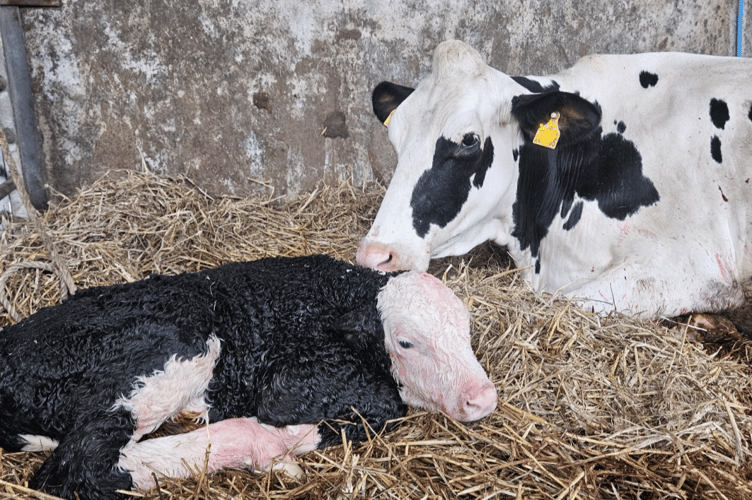
It was a normal Monday at South Moor Vets when the phone rang and I was called out to a cow that was having difficulty calving. Rich, the farmer, is pretty expert in these things. He’d spotted that she looked ready to calve earlier in the day and was keeping a close eye on her, but nothing was happening, and no calf was appearing.
A quick examination revealed the issue. I could feel that the birth canal was tightly twisted anticlockwise, making it feel less like the straight tube it should be and more like the gun barrel at the start of a James Bond film. This is called a complete uterine torsion. In other words, the uterus had managed to spin around 360 degrees inside the cow, so that its exit (the cervix) was twisted shut like when you twist closed the top of a plastic bag.
This isn’t all that rare in cattle; the twist usually happens in the first half of pregnancy, but it only normally reveals itself when the cow is ready to give birth but is unable to.
For some reason the vast majority of them are, like this one, anticlockwise. Whichever way they’re twisted though, it’s obviously a problem that needs to be promptly fixed -not only to allow the cow to deliver the calf, but also because the twist can block normal blood supply to the uterus and cause serious, even fatal damage.
Unfortunately, fixing them is not always very easy! We have several techniques up our sleeves (all of them involving those waterproof sleeves getting pretty covered!), but sometimes it can be very hard to rotate the calf and the uterus back to the normal position inside the cow.
And that’s not too surprising when you think that the uterus is not easy to get at and can weigh 70+ kg when full. (It always amazes me that the cow’s uterus can expand to the size of a big bin bag by the end of pregnancy and then shrink back to the size of a washing up glove within a few weeks afterwards.)
Unfortunately, not only was Rich’s cow’s torsion impossible to correct, but I could also feel that it had prevented the birth canal from dilating normally, meaning that it wouldn’t be a simple delivery even if I could untwist it.
I could feel that the calf was still alive and so the clock was ticking to get it out safely - it was time for Plan B.
After preparing the cow with painkillers and other supportive medicines, we launched into action and an hour later I had removed the calf by caesarean section, corrected the uterine torsion and stitched up the surgical site.


Fortunately, cows are perfectly happy to have procedures like this performed conscious, under local anaesthetic and painkillers, and so I finished the operation watched by my blissfully unaware but very relieved patient and, I’m glad to report, her very healthy newborn calf.
Comments
We've recently changed our login process. If you have an account for commenting, you will need to re-register on the login window.
This article has no comments yet. Be the first to leave a comment.