
Whilst visiting my friend Rosie and her parents in the Lincolnshire Wolds, they were keen to introduce me to the fabulous seabird colony at Bempton Cliffs in their neighbouring county of Yorkshire. So on one of the cooler days of our recent heatwave, we set off across the Humber Bridge and made our way to the coast.
We were greeted at Bempton by blue skies and a wonderful breeze which was welcomed after multiple days of unbearable heat. The visitors centre was buzzing with people, many of whom totally missed the joyful sight of baby swallows in a nest above their heads as they walked oblivious underneath. We stood and watched as the adults swooped in and out with food.
I had not expected such wonderful meadows running all the way to the edge of the cliff tops. So as we edged closer the sea, we enjoyed spotting a purple orchid along with an array of other multicoloured flowers and buzzing insects; all whilst tunefully accompanied by sedge warbler’s warbling from within the reedy meadows and reed buntings chirruping from bushes protruding from the long grass.
Our first sight of the seabirds was preceded by the pungent smell of guano along with the squeaky toy like calls of numerous kittiwake. Gannets cruised by the cliffs, with the odd one gaining enough uplift to rise and float over the tops of our heads before we had even seen the sea.
Reaching the first viewpoint, we took some time to marvel at hundreds of seabirds balanced precariously, with eggs and tiny chicks somehow kept safe on the tiniest ledges.
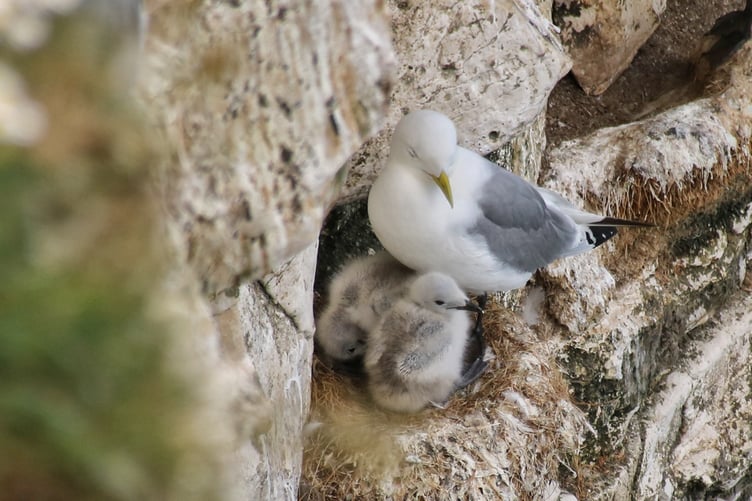
The shear rocky precipice in front of us was covered with Kittiwake, distinguished by their black legs and yellow bills and one of the UK’s smallest gulls. I was reminded of visiting a nesting colony of these birds at Hallsands 20+ years ago; a colony which has long since disappeared. In amongst the gulls, the odd razorbill stood out with their jet black plumage and thick black bill adorned with a bright white stripe.
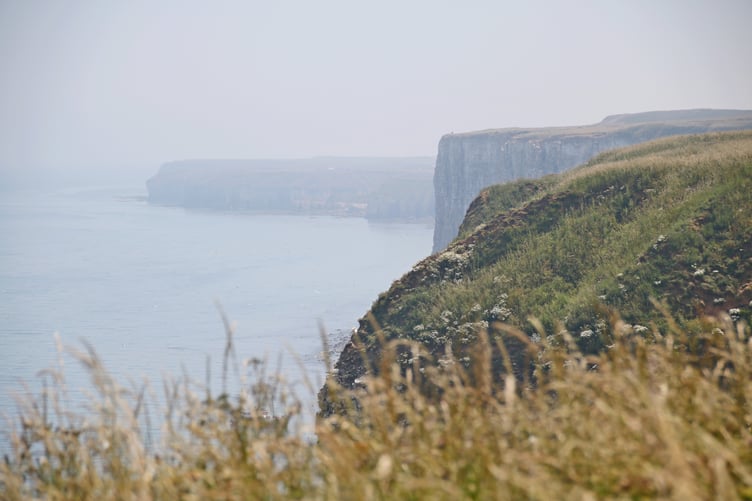
It is in these kinds of moments that I have to remind myself to look up and zoom out as it is so easy to stay focused on the spectacle in the foreground and miss out on the wider landscape. On this occasion the broader view afforded was of the incredible lofty cliffs to the south and of hundreds of birds sat on or flying across the surface of the sea far below. Gannets flew past in formation, and I spent quite a bit of time trying to photograph them as they whipped past; the resulting photos of which were mostly blurry!
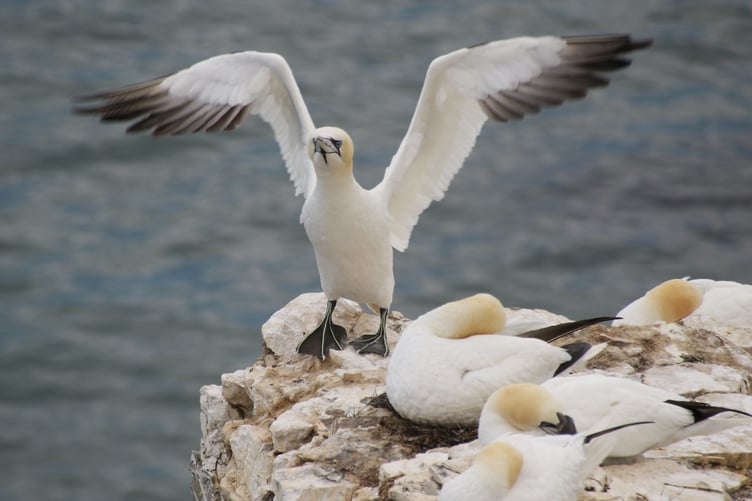
Around the corner gannets were nesting on a rocky outcrop and we spotted their young sprawled between their feet. Most of them looked lifeless, until a tiny twitch of their wing or beak told us that they were in fact alive. Some chicks were grey whilst others were pearly white, indicating the age difference between them. Gannet young are grey when they hatch with no feathers at all, then develop white fluffy down at about 3 weeks old which helps to



keep them warm (although I doubt they need it in this weather!). When they do eventually develop feathers, they are dark grey/brown, and will only become the brilliant white birds we know and love when they reach maturity at about 5 years old.
On a grassy ridge above the cliffs a spotty head popped up from amongst the wild flowers. This head belonged to a rather cute little herring gull chick. Mum (or Dad) came to join it with lunch, which unfortunately looked like a dead chick of some sort. Possibly one of the other baby seabirds had been unlucky and fallen off the cliffs. In the end the adult gull swallowed it whole, probably to be regurgitated later.
At the tops of the cliffs were the earthy burrows where we would have seen puffins, had we visited a few weeks earlier. Puffins are the last to arrive at the cliffs to breed and the first to leave, whilst Gannets arrive first and leave last. On this occasion, we had to settle for the occasional glance of a puffin in flight or sat on the cliff in the distance. By now many of them will be on their journey back out to sea where they overwinter.
Just below the earth, a blacky brown guillemot stood nudging its chick gently with its slender bill, keeping it from straying to close to the edge. A razorbill attempted to share the ledge but the guillemot wasn’t having any of it and proceeded to viciously peck at the intruder.
Just as I was pondering whether there were any fulmar around, out the corner of my eye I caught the rapid wingbeat of this wonderful albatross cousin. I watched it swoop and swirl until it disappeared into the throng.
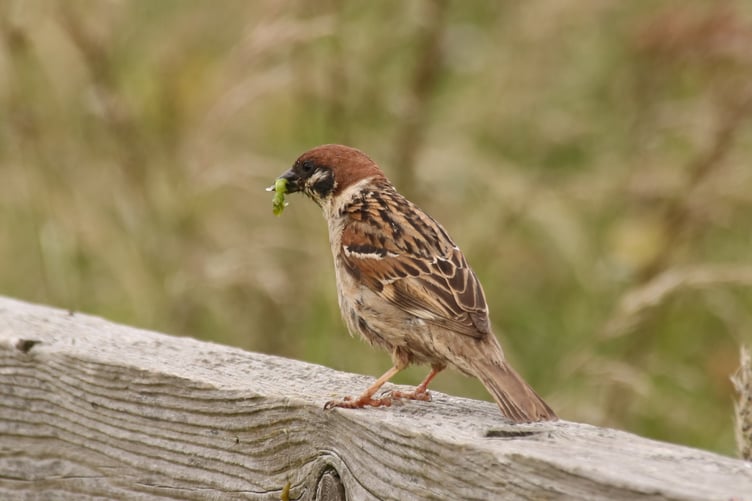
Walking back along the path, a small brown bird burst out of the meadow and landed on the fence in front of me and proudly showed me its find. In its beak a juicy green caterpillar wiggled before being swallowed whole. This inconspicuous bird was a tree sparrow, a red list species that has been lost from the South West of England along with many other places. This was my first ever sighting; and although the highlight of my day had to be the seabirds, seeing this gem was the cherry on the cake.
Comments
We've recently changed our login process. If you have an account for commenting, you will need to re-register on the login window.
This article has no comments yet. Be the first to leave a comment.