
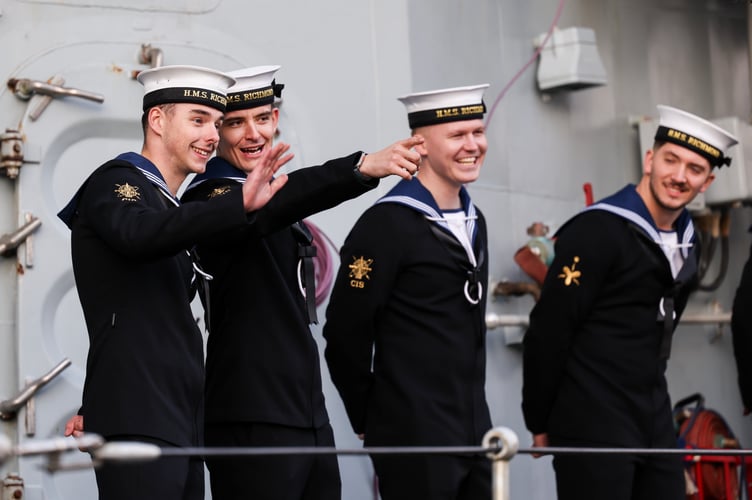
Hundreds of family and friends braved the rain to welcome HMS Richmond home to Plymouth as the warship completed an epic eight-month mission.
Since April the frigate and her 200-strong ship’s company – sailors, aviators and Royal Marines Commandos – have played an integral role in the Royal Navy’s premier deployment of 2025, Operation Highmast.
Richmond was part of the defensive ring of steel protecting the UK’s flagship, HMS Prince of Wales, as she led her Carrier Strike Group to the western Pacific Rim. The frigate was assigned to the force to provide protection against the prying eyes of hostile submarines and surface vessels.
But she also had the opportunity to strike out on her own at times, breaking away from the main task group to visit South Korea, Vietnam, Manila in the Philippines and Mumbai in India, in addition to taking part in major exercises in the Mediterranean, off northern Australia and Japan.




Commanding Officer Commander Rich Kemp said all the men and women in his charge could reflect “with real pride on the professionalism, resilience and teamwork shown throughout this demanding deployment.
“It has been a privilege to serve alongside our partners in the strike group, and to represent the Royal Navy on a global stage. This deployment has had many highlights. For me, I’ve seen more of the world in the past eight months than in my previous 22 years.”
His second-in-command, Executive Officer Lieutenant Commander James Callender, said he “could not be prouder” of his shipmates for all they had achieved.
“Whether it be supporting UN Security Council resolutions in the Yellow Sea or hosting dignitaries and VIPs for high level engagement, Richmond has continued to deliver in spades.
“We are now looking forward to the joy of homecoming and being reunited with the family and friends whose support has helped make this deployment possible.”
Richmond’s return to Plymouth is one of several by ships and squadrons as the deployment ends. The flagship and destroyer HMS Dauntless arrived in Portsmouth today, while Merlin and Wildcat helicopters have flown back to RNAS Culdrose and Yeovilton over the past ten days. And the task group’s main striking power, two squadrons of F-35B Lightning stealth fighters have flown back to RAF Marham in Norfolk.
In addition, Norwegian frigate HNoMS Roald Amundsen – an ever-present member of the carrier group – was greeted by around 100 of her countryfolk in Portsmouth, and tanker RFA Tideforce which supported the final month of the deployment, returned to Portland yesterday. Her sister, RFA Tidespring, provided fuel for the force through three-quarters of the Highmast mission, and is still on patrol.
Throughout, warships and support vessels from ten nations – including Canada, Spain, Australia, New Zealand, the USA and Japan – have integrated themselves with the task group.
Fifth-generation F-35 Lightning strike fighters of RAF 617 Squadron (The Dambusters) and the Royal Navy’s 809 Naval Air Squadron (The Immortals) have provided the fast jet firepower.
They have been supported by Merlin and Wildcat helicopters from 814, 815 and 820 Naval Air Squadrons, plus drones from 700X which have been pushing the boundaries of uncrewed air operations, in particular transferring supplies between ships in the group.
Comments
This article has no comments yet. Be the first to leave a comment.