
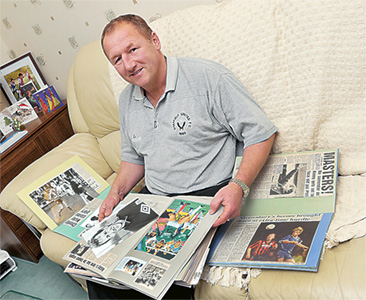
NICKY Marker played under two of British football's biggest names in Peter Shilton and Kenny Dalglish, and was part of Blackburn Rovers' fantastical rise to Premier League glory and Champions League participation in the 1990s.
It's therefore rather an improbable coup for Ivybridge Town to have a man, who was also a composed and classy central defender for Plymouth Argyle in the late 1980s and early 1990s, as their first-team coach.
But Marker has developed a strong affinity with both Town and the town of Ivybridge itself, having moved there in the late 1980s when he joined Argyle from Exeter City.
He kept his house in Gorse Road when he headed north to Blackburn Rovers to embark on an exhilarating odyssey, which saw him rub shoulders with the elite of English football.

And, after calling time on his memorable football career at Tiverton Town 10 years ago due to severely arthritic hips, Marker returned to the South Hams and got a job as a wood machinist at Princess Yachts in Plymouth.
But there was still a gaping void in his life at weekends which, since he was a young boy, had been consumed by football.
He firstly became involved with coaching Plymouth side Tamarside United, where his teenage son Samuel played, and also sated his lifelong, insatiable appetite for the Beautiful Game by going to watch Ivybridge Town on a regular basis.
Given his ubiquity at Erme Valley and developing friendship with manager of Town Brian Howard, Marker agreed to help out on the coaching side in 2009.
And, despite having played alongside the likes of Alan Shearer during his career, Marker was undeterred by the prospect of coaching at grassroots level.
As he confirms: 'I love football; what else would I do on a Saturday?'
The affable 46-year-old is now heavily involved in Town team selection, takes the training sessions and 'talks to the players before the game and at half-time', combining his coaching commitments with his day job in Plymouth.
'I also consult Brian (Howard) afterwards, probably when we've been beaten!' he quips.
Sleepy Ivybridge is certainly a world away from renowned cauldrons of world football, such as Old Trafford and Spartak Moscow's Luzhniki Stadium, which Marker visited during his memorable time at Ewood Park.
But Marker had absolutely no qualms about returning to 'dozy Devon' when he finished his professional career at Sheffield United in 1999, pointing out that he was born in 'a little seaside town called Budleigh Salterton where a lot of old people live'.
'I'm not one for the bright lights,' he admits. 'I'm quite happy here and have quite a few friends.'
After beginning his football journey at his hometown club at the age of 13, Marker joined Exeter City as a schoolboy and enjoyed the distinction of becoming captain of the club when he was just 18.
He then spent 'five wonderful years' at Plymouth Argyle, although the Greens were relegated from what is now the Championship under the stewardship of the legendary former England goalkeeper Peter Shilton in his final season at Home Park.
However, Shilton's managerial nous, or perceived lack of it, was 'quite disappointing' to Marker who, while at pains to stress he does not want to speak ill of his former boss, reveals: 'Shilton was trying to be another Brian Clough, but there was only one Brian Clough.
'He'd played at the top, he was the world's best goalkeeper when he played, and I thought he'd have learnt a lot.'
Marker's next career move ensured he really would receive an education in football par excellence, when he moved to Blackburn Rovers to begin 'a fantastic journey' in 1992.
While younger readers will associate Rovers today with relegation battles and supporter discord, 20 years ago they were arrivistes who established themselves as a powerful force in English football.
When Marker joined the nouveau riche outfit, Blackburn had just been promoted to the Premier League, galvanised by the wallet of the late steel magnate and owner Jack Walker, a local man.
Their inexorable rise to the upper echelons of the English game had also been masterminded by the former Liverpool manager Kenny Dalglish, who had resigned from the Anfield dugout in stunning fashion in 1991.
Blackburn's astonishing ascent to the Premier League coincided with a Sky TV deal which transformed English football into the monstrous money machine it is today.
It therefore comes as no surprise that Marker decided to join the Premier League new boys from Argyle without a flicker of hesitation in exchange for £200,000 and defenders Keith Hill and Craig Skinner.
He recalls: 'It was the chance to go and play at the highest level, so it was an opportunity I was going to go and grasp.'
However, the learning curve for Marker was steep, as he got to grips with training of a higher intensity than he'd been used to, as well as a more professional diet.
'It took me a while to get used to training; I used to go home absolutely knackered,' he remembers. 'Training with fitter, quicker and a better standard of players, you have to adapt or get left behind.'
The Rovers' revolution was rapid and included a dizzying whirl of transfer activity which left Blackburn's rivals fearful and envious as Blackburn set about recruiting a host of top players and prodigious performers from lesser clubs such as Marker.
Within his first three years as owner, Jack Walker spent £25 million on new players, a substantial outlay in those days.
Most notably, he twice smashed the British transfer record for the most expensive transfer of a football player, signing Alan Shearer from Southampton for £3.3million in 1992 and Chris Sutton from Norwich for £5million in 1994.
Such largesse reaped due dividends when Blackburn went on to win the Premier League title in 1995 in fairytale fashion, pipping the mighty Manchester United in the process.
Sadly, though, Marker made only one substitute's appearance for Rovers that season after snapping his right cruciate ligament the year before.
He therefore missed out on the memorable scenes of celebration at Anfield, where Blackburn were confirmed as league champions despite losing 2-1.
However, he did at least have a chance to join in the unbridled exultation to celebrate the historic triumph in the ensuing days when he joined 'the boys on an open-top bus in the town and the stadium'.
However, given his lack of involvement in the championship-winning side, Marker felt obliged to turn down a Premier League winners' medal.
'I felt I hadn't earned it but, in a way, I now wish I had taken it,' he admits.
Despite not making as significant a contribution as he would have liked to Blackburn's proudest moment in their history, Marker still looks back with immense satisfaction at playing a part in the club's halcyon days.
Scoring in English football's top tier was a particular highlight, he says.
'We played Tottenham and won 2-1 or 2-0,' he remembers. 'I scored a 12-yard header from a Stuart Ripley corner. I thought to myself: "Great! that'll get my name in the paper".
'But then some guy called Alan Shearer scored his 100th Premier League goal, which dominated the headlines the next day. I remember reports just saying: "And the other goal was scored by Nick Marker."
'But, to be honest, I was just delighted we won the game; that was the most important thing.' Another abiding memory from Marker's stint at Ewood Park is appearing in the Champions League in 1995.
But Blackburn's bow on the European stage left Marker feeling rather underwhelmed initially.
'We were in a group with Spartak Moscow, Legia Warsaw and Rosenborg,' he says, 'and that was a disappointment when we could have gone to places like Milan or Paris.
'Instead, we went to places you go to in pre-season like Poland and Russia.'
Despite conquering England the season before, Blackburn found continental opposition too hot to handle and finished bottom of their group after just one win from their six matches.
Although only a substitute at Spartak, Marker's memories of Moscow remain particularly vivid. He still retains a memento of his spell in the Russian capital – a giant bottle of whisky, which takes pride of place in his living room.
'I bought it in duty free for only £30 quid, but I don't even drink whisky,' he laughs. 'I remember when we got back to England after losing 3-0 and the customs guy saw me with the whisky and said: "Bad result, eh, guys?".
The game itself is also noteworthy for all the wrong reasons after Blackburn imploded in freezing conditions reaching 'minus 10 or 14' and were disposed of with ease by the classy Russians.
To compound matters for Blackburn, two of their players, David Batty and Graeme Le Saux, became infamously and risibly embroiled in a bout of fisticuffs after an argument during the game.
Marker also recalls the eye-opening, indelible sights of seeing 'people selling black bananas' outside the stadium and a lady 'who lived in a room like a cupboard near the changing room appearing with a pot of tea at half-time.'
But such instances of quaintness and frugality were nowhere to be seen during the heady days of mid-1990s football in England, which had been transformed immeasurably by the advent of the Sky television deal.
'I remember going to the big games which were shown on Sky, playing in front of full houses,' he reflects, with obvious relish at such happy memories. 'The old Arsenal ground, Highbury, which had heated floors, would leave you sweating in May. I played at both the old and new grounds at Sunderland and Newcastle, which was an experience.
'The games at Newcastle were particularly intense, with the ground full of screaming Geordies wanting to rip your head off.'
While Marker played in a time just before footballers' salaries rocketed to stratospheric proportions, he still enjoyed the trappings of a healthy salary.
He could therefore afford to be frivolous with his cash at times, once splashing out on a greyhound with teammate David May.
It's a move which which perplexes and amuses him in equal measure today.
'That was just for a bit of fun,' he smilingly stresses.
Marker also remembers being given a car phone 'the size of a breeze block' by Rovers before miniature mobile phones became de rigueur.
Less sturdy and determined players would have perhaps accepted an injury-enforced retirement earlier than Marker did.
The dogged defender was so keen to stave off the ravages of his deteriorating physical condition that he used to have cortisone injections on hips, which became arthritic when he was just 30.
And such indomitability was rewarded when Marker captained Sheffield United to the 1999 FA Cup semi-final, narrowly denied a final showdown with eventual treble winners Manchester United by Newcastle United.
In an interesting twist of fate, the scorer of the Geordies' only goal that day was none other than Alan Shearer.
Marker also led the Bramall Lane side to the 1999 play-offs, where they lost to Sunderland.
But he finally had to concede defeat in his battle with his body, moving to the less frantic nature of non-league football with Tiverton Town in December 2000.
Two hip replacements gave him 'a new lease of life', before he snapped one of them and had to have another operation last year after some over-exuberance in training at Ivybridge.
'They're (the hip replacements) meant to last for 15 years and one only lasted seven,' he points out.
Asked whether he regretted not having played in the current money-drenched age in which even average Premier League players are millionaires, or the fact that he played only 53 games for Blackburn in five years at the club, Marker replies unwaveringly: 'That was my time; I can't change anything about it. Players who played 20 years before me probably felt the same (envy) about what we earned. I did what I loved doing.
'I wish I'd played every game; I wish I'd never missed a game. But not many people play in the Premier League, do they?'
Marker's refusal to cut the umblical cord to his lifeblood of football means he now experiences another type of anguish, that of a fight for survival with Town in the Premier Division of the Carlsberg South West Peninsula League.
After returning to the Greens late last summer following his injury-enforced lay-off, he and manager Brian Howard were faced with formidable challenges on and off the pitch.
There was a mass and unexpected exodus of nine players from Erme Valley, for starters.
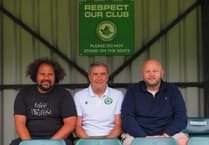
What's more, following a ground redevelopment, including the installation of a smart 100-seater stand last year to meet league requirements, it's taken a while for the new pitch to be 'bedded in'.
The playing surface has therefore routinely cut up badly during wet weather, causing a host of postponements and creating a backlog of fixtures which Town are still catching up on.
The cumulative effect has resulted in the Ivies sitting third bottom at the time of writing.
It's no surprise, therefore, given the club's catalogue of misfortune, that Marker says league survival would represent a successful season for the Greens.
'Brian (Howard) decided to go with young players, and our priority is definitely to stay in the league,' he admits. 'The good thing is a lot of them (the young players) are Ivybridge-based lads, which is good for the town. But most of them come from the lower leagues such as the South Devon League or junior football. It's a big step up for them and they just need a bit of luck and belief to improve. Some results have flattered the other teams this season, but we're now playing teams in the mid-to-lower reaches of the league.'
While Marker greatly enjoys his coaching role, he concedes he experiences regular frustrations with amateur players unacquainted with the rigours and polished practices of professional football in which he was inured.
'They (the players) do things they shouldn't be doing, then still make the mistakes,' he says. 'When you're a professional, if you don't do what the manager says, you won't be playing, so you don't make the same same mistakes.'
He says a particularly intractable problem has been Town's concession of 'sloppy goals at the back', but he admits this is not surprising given that the back four he and Howard have to field at times are '17, 18 or 19'.
Marker says his approach to coaching is not to bawl at youngsters continually if they slip up, but says: 'I tell them some home truths if necessary.'
He adds: 'At the end of the day, I'm hoping to improve them as football players. If we go down, I can't ask any more as long as they give me 100 per cent.
'The good thing is see them improving. In our first league game of the season away at Witheridge, we didn't have a shot on goal and lost 4-0.
'Young players are going to make mistakes; professionals make mistakes too. As long as they react in the right away, I'll buy them a coke after the match. But don't print that!'
Unsurprisingly given Marker's pedigree, Howard is thrilled to have him on board.
He said: 'He's an integral part of the club, with vast experience. The young players really look up to him and listen to him due to the experience he has.
'At the start of the season, we had an influx of young players and he's started to mould them into decent players and we're gradually improving. He's very valuable to the club and anyone would be delighted to have someone of his experience on board.'
Ivybridge Town have a man with a wealth of experience of football at the highest level on board, while they have given Marker something to do on a Saturday.
Long may this symbiotic and successful relationship endure for both parties.
Comments
This article has no comments yet. Be the first to leave a comment.