
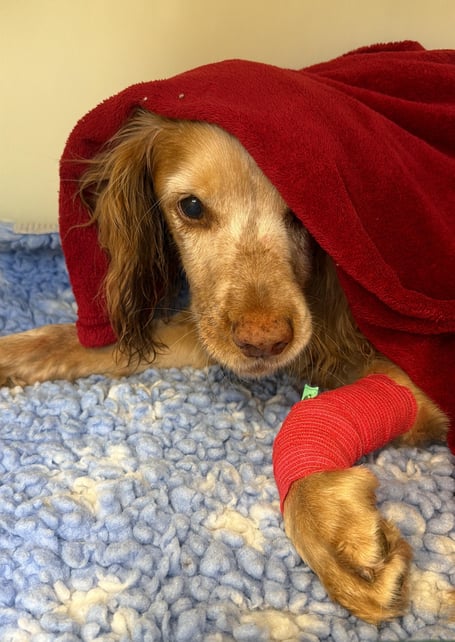
As nurses, we treat every patient we meet as if they are our own. However, every once in a while, a VIP (very important pet!) will be added to the procedure list for the day.
Earlier this year it was the turn of my family dog, Hamish the golden cocker spaniel, to come in for a quick teeth clean under general anaesthetic - or so we thought! Hamish had previously been in to South Moor Vets for his annual vaccination, dental check (and gravy bones!).
Whilst his teeth had always been noted to be in pretty good condition, this year a descale was recommended which is not unusual for a nearly 9-year-old dog.
Hamish was happy, healthy and eating well so we had no concerns that a quick descale would be all that was required. Tartar on dogs’ teeth hardens over time and harbours bacteria, which causes gum disease and tooth decay, so it’s important we deal with it when necessary to prevent oral and systemic health problems as well as oral pain.
Hamish was smoothly anaesthetised and taken for full dental radiographs (x-rays) with one of his favourite vets, Ruth. "Um Grace..." Ruth said "I'm afraid Hamish needs four pre-molars removing". Removing these teeth is a big job, they have two roots and are often rather reluctant to come loose.
Hamish's quick descale suddenly turned in to a much bigger procedure. The dental radiographs showed what a visual examination cannot. The roots of these teeth had evidence of resorption and ankylosis - this where the body starts breaking down and absorbing the tooth and periodontal ligament.
Meanwhile the tooth and gum above the surface were healthy, which explains why we were not aware of this before. This would have been quite sore for Hamish, but we would never have guessed from his bright & happy behaviour. Animals are very good at hiding signs of dental pain.

The decision was made to "stage" Hamish's dental, which means completing the procedure over two or more general anaesthetics. This results in a shorter anaesthetic time for our patients, reducing the risk of hypothermia (becoming cold), hypotension (low blood pressure) and various other complications we may encounter with a long general anaesthetic.
A common misconception is that multiple general anaesthetics are bad. Actually, multiple shorter anaesthetics can actually carry fewer risks than one big long one. As dentals are routine procedures rather than emergency, we have the luxury of being able to make this kind decision for our patients.



Two anaesthetics and four fewer teeth later, Hamish is back to his bright and bouncy self and my nerves have just about recovered from monitoring his anaesthetic! This experience confirmed the reason dental radiographs are so important and therefore included in every dental procedure here at South Moor Vets. What we can see above the surface can be a very different story to what is going on underneath.
Comments
We've recently changed our login process. If you have an account for commenting, you will need to re-register on the login window.
This article has no comments yet. Be the first to leave a comment.