
Managing money can test the most prudent of households, but the stakes are much higher when you’re helping oversee spending decisions that could impact hundreds of thousands of people.
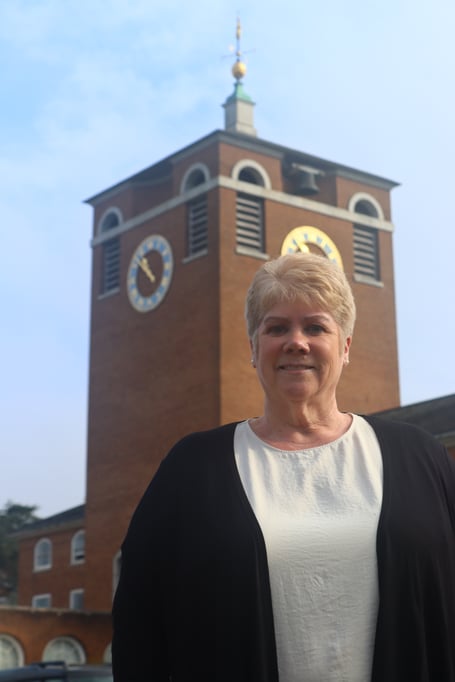
Angie Sinclair has spent her entire career involved in council finances, but as her retirement at the end of March nears, the job hasn’t got any less tumultuous.
“It’s definitely chaotic,” she says, remarking on the up-against-the-wire approach the government has increasingly taken to announce how much money it would be giving councils like Devon.
Local authorities have been begging ministers to declare grant levels much earlier in the budget-setting process to give them more time to work out how much they can spend and where.



The government did grant one wish this time by outlining its council funding plans for the next three years rather than just for the next 12 months, but it only confirmed the figures at the very last minute.
“The initial settlement was just a few days before Christmas,” the director of finance recalls, “with the final settlement later in the year than ever.”
Councils are bound by a statutory deadline of February 28 to ratify their budgets, so with Whitehall only confirming figures this year on the 9th of that month, it made Ms Sinclair’s penultimate month of work more frantic than she’d hoped.
While she remembers that those on the receiving end of Westminster’s council funding decisions have nearly always said there is “not enough”, she believes the pressures now are much greater.
Indeed, government funding for the forthcoming financial year will be broadly flat when council tax is excluded, but cuts of nearly £7 million are expected in each of the following two years.
“Looking back, we didn’t know we were born,” she says.
“When I started here 18 years ago and we were pulling the budget together, the conversations were all about bidding into a pot of money to expand services, not about savings.”
That drastically changed shortly after Ms Sinclair joined the county council in 2007, with austerity kicking in soon after the 2008/09 global financial crisis.
“Wow that was tough,” Ms Sinclair remarks.
“In some of those years we were having to find £40 million to £50 million in savings every year.”
Ongoing cuts from central government mean the amount of money councils have has “significantly reduced” during Ms Sinclair’s career, even as demand has continued to rise.
And for a rural county like Devon, there have been more recent blows too.
“We’re definitely misunderstood,” Ms Sinclair states.
“The government’s policy now is that it wants to refocus funding on urban areas with high levels of deprivation, but if there are winners then there have to be losers too.
“We have pockets of deprivation here but they don’t rate in the way urban ones do.”
She recalls the “shock” when Devon lost a £10 million rural services grant in December 2024, money aimed at supporting rural counties due to the extra expense of delivering services compared to their urban peers.
“Something like that is normally trailed but it wasn’t and it disappeared overnight,” she adds.
“We managed, but it was tough.”
Ms Sinclair, a born and raised Devonian, says the government has “not recognised the additional cost of running rural services”.
“That’s a biggie,” she says.
“Devon spends £50 million a year transporting children to school. Other councils don’t have that expense and that’s just one example,” she states, adding that there are plenty more instances where Devon has to pay more to provide services than more urban peers would need to pay.
And that isn’t down to inefficiency, Ms Sinclair stresses, but simple geography. Essentially, for example, a social worker in Devon is likely to have to travel far more miles to visit their clients than one of their city peers.
Given she entered the local government finance sphere straight out of Bideford College by entering into an apprenticeship in 1983 with Torridge District Council, Ms Sinclair has seen the proverbial booms and busts of council funding.
Margaret Thatcher provided a seminal moment for council finances when she introduced compulsory competitive tendering, where councils had to open up in-house manual services – such as maintenance and refuse collections – to private suppliers in a bid to cut costs and improve value for money.
Ms Sinclair, who at that time was employed by North Devon Council, acknowledges local government “didn’t have a great reputation”, and that Thatcher’s policies were aimed at “trying to make it more efficient”.
“Looking back, it was needed and the time was right, but it had a limited life, and that was probably also right,” she said.
“It did drive savings, without a shadow of a doubt, and made the management of those services more performance-orientated and value-for-money focused.”
She says while offering contracts out to the private sector isn’t compulsory in the way it was under Thatcher, the focus on best value remains.
A common refrain nowadays in the corridors of councils up and down the land is ‘efficiencies’, a slightly nebulous phrase that some politicians tend to read as cuts to services.
But Ms Sinclair, who is an employee rather than an elected member stays well away from politics, states that isn’t the case.
“We’ve entered into a partnership with [consultancy] Newton, and that’s about getting better outcomes for adult social care services at low cost,” she says.
“It’s not about taking services away, but about being more efficient and finding better outcomes at lower cost.”
Given adults’ and children’s services make up around 80 per cent of Devon County Council’s revenue budget, making the money work better here is vital.
She points to other initiatives, such as the council’s desire to build its own children’s homes, something that would reduce the reliance on expensive private placements.
Much of Ms Sinclair’s final year in her post has been dominated by the government’s desired shake-up of local councils, known as local government reorganisation (LGR).
If achieved, it will mean Devon’s two-tier system whereby the county council has responsibility for some services and district councils oversight of others – all within the same administrative area – will be replaced with a unitary system.
This will mean Devon’s current 11 councils could be replaced by just three or four larger, unitary-style councils.
That could mean there are fewer roles available in the council sector, particularly at a more senior level.
But Ms Sinclair says that LGR “did not expedite my decision to retire”.
“I was always going to go now,” she says.
Based purely on the numbers, she believes, with the calm confidence she routinely exudes, that Devon County Council’s proposal makes the most sense.
County Hall believes the county council’s footprint should remain, but just one council should oversee all the services compared to the situation now where responsibilities are split between the county authority and eight districts.
The main competing proposal – 4-5-1 – would merge four existing councils into one council, five of them into another, and leave Plymouth as a unitary.
But Ms Sinclair believes the rival suggestion has overrelied on average costs.
“For instance, the bid has taken the average cost of adult social care and extrapolated it as being the same cost per head of population, but cost drivers don’t work like that,” she says.
“Our modelling is based on where assets and people are.”
Essentially, she states, an area such as the South Hams has more people who self-fund their social care than Torridge does, meaning a strategy that believes those two areas rely equally on council-funded social care would be erroneous.
“We know where the costs fall and we have been able to model that,” she adds.
As she takes stock of her frenetic final year, Ms Sinclair’s thoughts turn to her retirement.
“Some people retire from this type of role and become consultants, but I’m properly retiring,” the 59-year-old beams.
“I’ve got a brand new great niece, Edith, so I’ll be looking after her and, of course, visiting great-grandson Luca.
“And I’ll be spending time with family and friends, and I love crafting, walking, and, of course, holidays.”
While she’ll be “living the life Devon has to offer”, she has a “big holiday” planned soon which will see her embarking on an enviable adventure in North America, including taking in Canada and Alaska, then ending in the Caribbean.
“I think that’s when it will hit me that I’ve retired,” she says.
Comments
This article has no comments yet. Be the first to leave a comment.