

Lots of events are being organised across the South Hams to mark Remembrance and 100 years since the end of the First World War. Kingsbridge
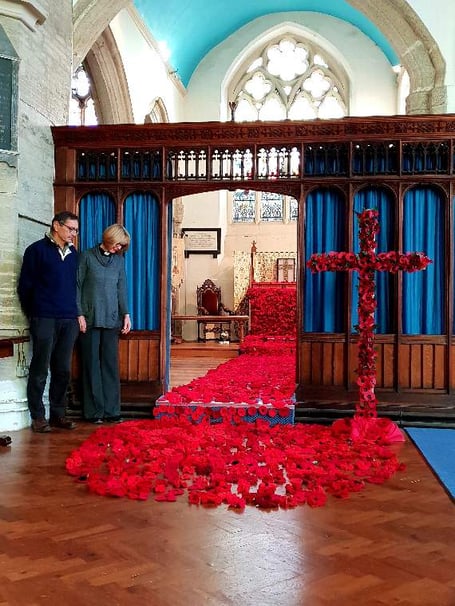
In St Edmunds Church there is a poppy installation made of 2,500 knitted poppies made by local residents and some visitors - some as far away as Bath, Surrey and the Cotswolds.
The poppies now flow down from the alter in the Lady Chapel at St Edmund’s and down into the main body of the church. The placement isn’t random, with the alter in the Lady Chapel being the First World War alter, donated by the people of Kingsbridge in memory of those they had lost. The engraving reads “Given by the people of Kingsbridge in memory of those who laid down their lives in service in the Great War”.
The installation will be unveiled at Poppy Appeal launch service hosted by Kingsbridge and District Royal British Legion in conjunction with St Edmund's Church, at 10am on Sunday, October 28, and they will stay there until November 15. During the service, which will include the Kingsbridge Silver Band, the congregation will be given a paper poppy to hold and remember. At the end of the service those poppies will be added to the installation.

Duncan McDonald, churchwarden, put out a plea for knitted poppies in August for the installation, and hoped to receive a thousand. A clear perspex box was set up in the church to receive the poppies, and people came in and donated their creations, so the team at the church have no idea how many people actually donated.
The Rev Jackie Taylor, St Edmund’s Church, said: “Sheila Strachan came up with the idea of creating something like this, but I don’t think she ever thought it would take off like this. Its been lovely to have people from the community come and sit and chat while they have been stitching them all together.
“It really is an act of community remembrance, and I love that each one is as individual as the people they remember, I think lots of people would have had a specific person or people in mind as they knitted.”
There were also a handful of white poppies, displayed around a vase of white flowers. The white poppy has been a symbol of peace for the last 80 years, and the Peace Pledge Union says they represent “remembrance for all victims of war, a commitment to peace and a challenge to attempts to glamorise or celebrate war”.
Everyone at St Edmund’s Church would like to thank all those who gave their time to knit poppies for the installation, which the church team worked late into the night to prepare.
*
Stokenham
Stokenham History Group are holding an exhibition in St George’s Church from November 1-17.
The display is woven around the men commemorated on the War Memorial, all of whom were from Stokenham parish.
Their display has pictures of life in the parish at the time and what the men did in the war. It looks at the occupations they had before they joined up, and at the families they left behind. It provides details of their service and reports on where they died and were buried, and shows how they were remembered.
A Stokenham History Group representative said that the Roll of Honour for Stokenham, thought possibly to have been kept in the church porch, has been sadly lost, so they are asking for any information on family members.
They said: “If you have any information, names or regiments, we would be interested in following these up. Many of the army records were lost during the Second World War.
“We have found that many people do not know about their great uncles or grandfathers who fought in the War, and you may be surprised to find an unknown relative. We have family trees for the men on the War Memorial.”
If you have any photographs, contact Fran Ansell on 01548 511325.
*
Modbury
St George’s Church, Modbury is bringing to life the names of the Fallen from the First World War.
Awarded a Heritage Lottery Fund Grant from the First World War Then and Now programme, the Modbury Remembers project has researched family background, where they lived, served, fell and are buried to produce a comprehensive archive.
There will be a public exhibition of their stories in St George’s Church from October 20-27, which will display Modbury life in the 1900s, showing the impact of military service and war on a rural community, as well as letters home from the front line.
On October 27, the Modbury branch of the RBL will also launch their Poppy Appeal, with street collections during the day.
The Poppy Appeal will be officially launched by Retired Squadron Leaders in the RAF, Ted Squire, along with the traditional visit from the military vehicle outside the Post Office.
Outside the Church there will be a unique version of the ‘Lost Lives’ exhibition that gives a graphic sense of the large numbers killed, similar to the one currently being displayed at the Thiepval memorial in France before moving to the Olympic Park London in November.
One shrouded figure, hand stitched by artist Rob Heard for the Shrouds of the Somme Exhibitions, is laid out to represent each of the 52 months of the First World War and records on a small plaque the number lost each month.
There will also be an art exhibition, ‘Beyond the Trench ‘ where local artists have captured the Home Front and role of women during war.
A booklet recording the information collected is being produced and a copy will be given to each child in the School and to relatives of the Fallen. A presentational copy will be held with the Roll of Honour in the Remembrance Chapel in St George’s Church.
There will also be coffee and cake in the Modbury Club on Saturday, November 3, between 10am and noon, and a coffee morning on Saturday, November 10, at the Exeter Inn, with a grand raffle draw, also between 10am and noon.
*
Ivybridge
In the Watermark, the Ivybridge Heritage and Archives Group will be putting on special week-long exhibition featuring the men of Ivybridge who served in the war and will include new research detailing previously unidentified servicemen from the town.
The exhibition will also uncover what was happening in Ivybridge during this time, as well as focusing on more general aspects of life during the war years. Memories, songs, poetry and articles will give an insight into what happened to local people and the town during the four years of The Great War.
One section will be dedicated to the Roll of Honour, the War Memorial and the stories of some of the men born in Ivybridge who joined up and fought for their country.
The RBL has also revamped ‘Harry’s Patch’, a play on Harry Patch’s name, the last surviving soldier to have fought in the trenches, a space dedicated to the commemoration to the First World War, which has been developed further this year using designs from the children at Ivybridge Community College.
*
Brixton
An exhibition to mark the lives of the 13 men from Brixton who died in the First World War and the 96 men and women on the Brixton Roll of Honour will be held in St Mary’s Church, Brixton, between November 8-10.
It will remember their lives, their families, local links to the community today and celebrate Brixton 100 years ago. The exhibition will be open daily from 11am to 4pm.
The programme for each day will include ‘in conversation’ with people who have childhood memories of Brixton in the 1930’s and close links to those who died and those named on the Roll of Honour. On Friday, November 9, at 7pm, there will be a talk on ‘Farming in this area in WW1’ by David Pinder, chair of Wembury History Society in the church.
13 trees will be planted in Brixton, later in the year, to remember the men who died.
Personal effects and photographs of Brixton 100-years-ago will be on display and there will be an opportunity to try the food eaten then. The church gates will have lit silhouettes of soldiers and the church will be decorated in memory of all those who served with nearly 200 poppies knitted by ladies from Brixton.
*
Aveton Gifford
An exhibition named ‘Aveton Gifford in the Great War; Lest We Forget’ will be open for three weeks from November 9, in the Ladies Chapel of St Andrew’s Church between 8am and 3.30pm every day.
120 people from the parish of Aveton Gifford served in some capacity during the First World War, and of those, 20 servicemen are known to have lost their lives as a direct consequence of their war service.
Our Roll of Honour records the names of 96 people who served, and official records, family information, and newspaper reports have been available to identify these names.
In addition, since their commemorative exhibition in 2014, more has come to light about another 20 servicemen whose names were not included here, and another four men who also lost their lives. This exhibition pays tribute to all of them.
Comments
This article has no comments yet. Be the first to leave a comment.