

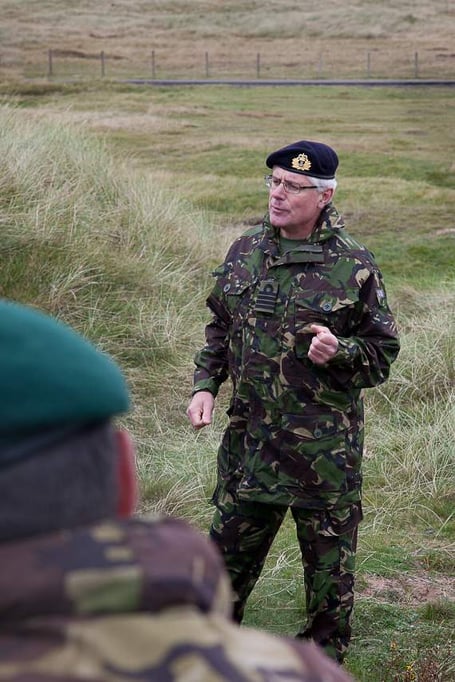
A FORMER high-ranking naval officer from Ivybridge has launched his campaign after being officially named Labour’s candidate for police and crime commissioner.
Gareth Derrick will fight the election on May 5, hoping to replace current PCC Tony Hogg.
Mr Hogg himself has come under fire recently for the reported £500,000 cost of a planned office move to Devon and Cornwall Police’s headquarters at Middlemoor in Exeter. But he has also received praise for his tough stance on funding, delaying a proposed central government cut for the region’s force.




Gareth decided to start his push for the PCC job after finding himself ‘pretty upset’ at the political scene following last year’s general election. Seeing the Conservative’s ‘very definite policy of austerity’, in particular the big cuts to policing, he was persuaded to try and give people an alternative.
His campaign is based on Labour values and crucially, he says, on not cutting frontline staff.
Gareth said: ‘I make no bones of the fact that my values are aligned to the Labour Party and that involves fairness, justice and a commitment to the idea that we can work together to make things better in our society.
‘I’m very proud to be campaigning under the Labour banner and deliberately chose not to put myself forward as an independent because I want people to know what I stand for. I wouldn’t want people to be uncertain as to what my values were.
‘People should ask themselves the question: given what the government has shown it is prepared to do to policing, would you want someone who’s aligned to the same party as PCC?
‘Clearly the PCC is not in charge of everything. But if I had the choice, I wouldn’t have cut £50 million from the police budget in Devon and Cornwall, I wouldn’t have forced the job losses of more than a thousand people, 500 police officers and 500 civilian staff including PCSOs.
‘I wouldn’t be planning to shut down even more police stations – and Ivybridge is down to go - it just doesn’t feel right to me.
‘It’s something I find objectionable, because it’s linked to a fairly arbitrary target for budget reduction based on the chancellor‘s ambition to become prime minister.’
The PCC hopeful, who briefly served as an Ivybridge town councillor before standing down to focus on his campaign, is clear that his first priority is to establish the level of funding that Devon and Cornwall Police will receive. After that, he must draw up a fully costed plan by the start of the next financial year.
His priorities, should he be elected, can be summarised as connecting police with communities and maintaining frontline staff, ensuring the right policing is provided in the right areas in this most diverse of regions.
Gareth explained: ’My role in the immediate term would be to put maximum effort into getting the funding sorted out. Because unless you know the level of funding you’ve got, you can’t plan.
‘There’s no way that where we’ve got to is going to be completely reversed, it’s just not going to happen realistically, but even with the supposed settlement by George Osborne last autumn, police finances are still in a very difficult position.
‘So my first job is to get on the phone to the chancellor as much as I can and push him and his team to come up with a proper, long-term settlement for funding. Until that is nailed down, one cannot really define what the level of policing can be.’
Gareth, like Mr Hogg, is sharply critical of the formula used to calculate central government funding for police forces. He continued: ‘The formula is based on population, and factors like levels of deprivation in urban areas. It turns out, as uncovered through the work of Tony Hogg and his office, this particularly works against Devon and Cornwall because we have dispersed, low density populations.
‘So the funding formula as it is today would have meant another £15 million to come off the budget. He has fought that, and held the cuts at bay, but we don’t know what the new formula’s going to be.
’The PCC cannot solve that, but he can work to get the best solution for Devon and Cornwall, and that’s what I’ll be doing.
‘I really want to restore the feeling of mutual trust and confidence in policing. I’m not in any way saying that people don’t trust the police, far from it, but there are lots of people out there who aren’t as confident as they should be that they can actually contact the police to deal with their issues. The 101 service is appalling, and Tony Hogg acknowledges that.
‘People aren’t sure they’re seeing enough of the police. So what I want to do is restore that feeling of ‘one team policing’ where, across the police, across safety partnerships in our communities, and ordinary members of the public, everyone feels that they’re working together, and that the police are doing the right thing for them.
‘That’s a big ask, but that’s my overarching mission. My aim would be to focus on what I’m calling effective local policing, and I do think there’s a very important role for visible policing on the streets, with police officers and PCSOs out there. There’s a great risk they’re going to be cut.
’I believe there’s an opportunity to make a commitment about the level of community policing you can expect. Make a commitment, and be measured against it. That has not happened so far, and it’s something I think I could work on.’
Gareth also believes his experience of senior leadership roles in the forces would stand him in good stead in the role of PCC, and may give him an edge in this area over other candidates.
He said: ‘Every candidate’s different, and while I’m not heavily steeped in policing work, I have been involved in senior management and leadership positions which in some ways are similar to the police, in the military forces. So I think one of the things I can bring is experience of leadership of a large team at the strategic level.
‘As an example, as deputy commander of the Maritime Reserves in 2012 we mobilised a significant number of Navy and Royal Marines reservists to rectify the huge security shortfall at the Olympics, due to the failure of G4S.
‘G4S couldn’t come up with the people, and so our reservists were required at short notice to do it. About 600 reservists were put into security operations there. That wasn’t me doing everything, that was me heading up a team of people.
‘I use that example because firstly it’s a leadership example, but also it’s an example of how risky it can be using private companies to deliver security.
‘I’d fight that all the way, but I feel that if the cuts continued along the lines that were being talked about last year there’d be no option, communities would have to start buying their own policing. That would be a terrible shame.
‘I do really believe it’s critical that policing, the armed forces, the NHS and some other areas are maintained as fully as possible in the public sector.
‘We all have experience of companies that are driven fundamentally by profit, and that is not the right way to approach these tasks.’
Anyone that wishes to put a question to Gareth in person will be able to do so at a free public Question Time-style event at The Watermark, Ivybridge on March 17, where he will be on stage alongside MP Ben Bradshaw and Youth Parliament member Sarah Staples between 7.30pm and 9.30pm.
Comments
This article has no comments yet. Be the first to leave a comment.