
Last Christmas I gave my eight-year-old granddaughter Anise membership of Devon Wildlife Trust’s (DWT) Adopt a Beaver Club.
She enjoyed the cuddly toy and the information pack, but on their own these constituted an underwhelming Grandpa present.
As a result, I included a promise that we would go on an adventure to see real live beavers this summer.
On an evening at the end of May we arrived at the downstream end of the river Otter, just east of Budleigh Salterton, to meet local guide Chris Townend.



Here the river is wide and deep, so beavers do not need to build a dam to raise water levels.
There is a good footpath on the western side leading upstream to Otterton Mill. Willow shrubs and bankside rushes give intermittent cover along this side and a taller flood bank, with thicker cover including trees, lines the far bank.
Chris told us about the history of the beavers on the Otter, which resulted in Defra giving permission for the animals, which DWT had captured for health testing, to be released back to the river in April 2020 and allowed to form a free-living population.
He told us there are now 15 family groups on this river system, spaced out in individual territories.
They breed once a year, in April or May, and the three or four kits are carefully tended by their parents.
After a short walk upstream, we saw a couple of photographers standing in a patch of bankside nettles, excitedly pointing their cameras at the water.
They ran downstream to take up a new position and we followed them to see a broad head and the top of a wide body sailing serenely down with the flow.
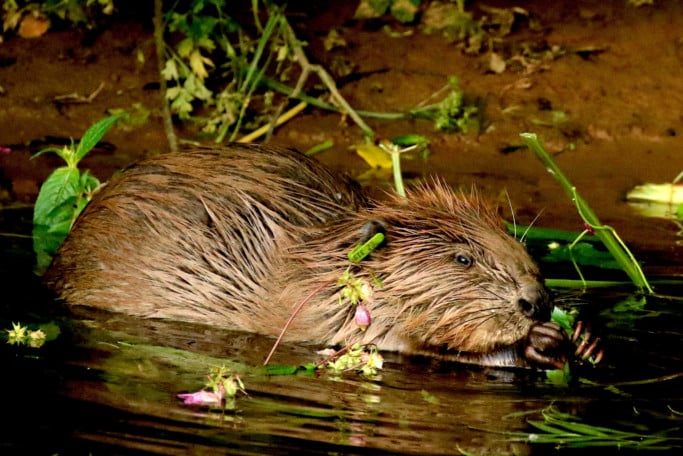
We also ran ahead and past obstructions to keep the animal in view, till it hauled out on the far bank, sat up like a tame bear, and proceeded to have a good scratch and brush-up.
We saw she had a pink ear tag, put in by DWT, and which led to her being called Patricia.
She was very fat and her nipples were swollen telling us she was lactating and clearly feeding this year’s kits.
Chris told us the young did not leave the lodge for the first six weeks or so, and were probably being guarded by the male (Gordon with a green ear tag) at home while Patricia was out for a break and some food.
Anise got a good look at this mum, with her two small front feet and huge webbed rear feet.
The smallest two toes on these were very close together, forming a comb used to squeeze water and mud out of her fur.
Her impressive teeth were an alarming orange colour, the dentine infused with iron to make them strong cutting chisels.
We walked on and saw three more smaller beavers, last years’ half-grown kits, and busily engaged in stripping leaves and bark from thin willow branches.
Many branches had been cut off, leaving distinctive teeth marks.
We saw the family lodge, just a tangled mass of branches raised a couple of metres above the water on the steep far bank, and with muddy tracks leading up out of the river.
The light was beginning to fade as we walked back down river, with owls hooting in the distance and mayflies skittering off the water surface, their wings just catching the light of the setting sun.
As we crossed a bridge and looked upstream at the silvery water surface, my daughter Lauren called "look there’s the mother beaver swimming back upriver.
’She must be heading back to feed her babies."
Comments
This article has no comments yet. Be the first to leave a comment.