

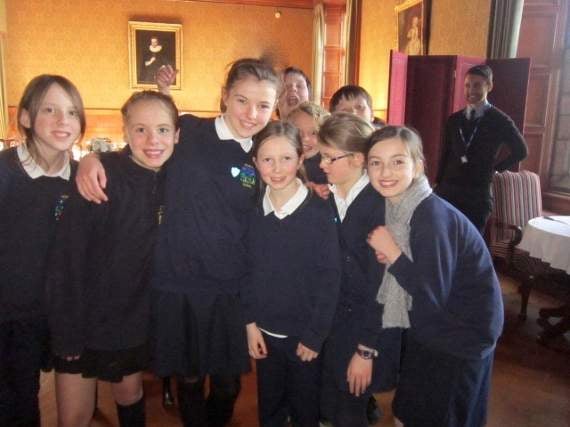
WHERE can you study the Tudors without spending time and money travelling miles?
That was the challenge facing Holbeton Primary School Key Stage 2 teacher Harry White recently. But luckily for him, village children have history on their doorstep.
Mr White spoke to school governor Anne Mildmay-White, who offered to arrange a visit to Flete House to learn about Mildmay family history in Tudor and Elizabethan times.
The Grade 1 listed building was the Mildmay family home before becoming a maternity hospital in the Second World War. Now the house is divided into twenty nine apartments occupied mainly by retired people.


-Cleared-for-use-by-LDRS-partners.jpeg?width=209&height=140&crop=209:145,smart&quality=75)

After a welcome from Flete’s administrator David Sparks, the group visited the gardens to see the former Elizabethan entrance, private family chapel, and the wishing well formerly the house’s private water supply.
Back indoors Anthony Mildmay-White told the children some early Mildmay family history and showed them a portrait of Sir Thomas Mildmay of Chelmsford. He was auditor to the Court of Augmentations established by Henry VIII to administer the properties and land he confiscated following the dissolution of the monasteries.
Sir Thomas featured in Hilary Mantel’s book Wolf Hall about Thomas Cromwell, who helped Henry leave the Roman Catholic Church, and condemned his wife Ann Boleyn to death.
Sir Thomas’ son Sir Walter Mildmay was Queen Elizabeth I’s chancellor of the exchequer, and quite a favourite. They exchanged gifts, including a large emerald and diamond ring engraved with her name and the date which the children were lucky enough to have a look at.
Flete’s best painting from the period, a Zucchero portrait of Queen Elizabeth I, is currently on loan to the National Trust. But the children got to study old family portraits to see the clothes then in fashion, and some original documents from the Tudor period with elaborate but illegible spidery handwriting.
Mr Mildmay-White also showed the children an extraordinary painting of a Mildmay from the time of Charles 1, and told the strange story attached to it. Henry Mildmay was one of the nobles that condemned Charles I to death, but following the Stuarts’ restoration to the throne he and the others were sentenced to be dragged round the town of Tyburn, then hung, drawn and quartered.
Henry did not fancy this and fled to Antwerp, decreeing he should be painted after his death to show he had not suffered the same fate.
The picture shows bedsheets cut away, exposing hands and feet, thus proving he was not disgraced as a regicide.
Although Charles I was a Stuart king, and therefore not strictly speaking relevant to the Tudors, the creepy painting caused great excitement among the children.
Holbeton head Jackie Rundle said: ’The children thought it would be a boring tour of a house, but they were buzzing with excitement when they returned.’
Anne Mildmay-White said: ’We loved bringing history to life for the children, and giving something back to Holbeton primary school. It’s a wonderful happy little school, with big ambitions for its pupils, and certainly our three children’s years there made a lifelong impact on them.
’I’m looking forward to our grandchildren joining in the not too distant future.’
Comments
This article has no comments yet. Be the first to leave a comment.