

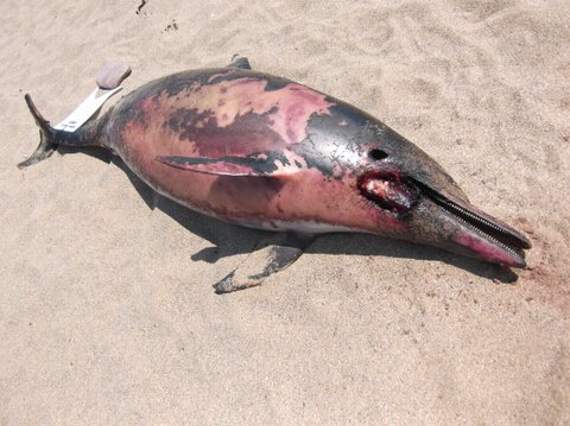
A SPOKESMAN for the Natural History Museum has explained why a dolphin washed up on Thurlestone Sands was not picked up.
A spokesman for the Natural History Museum said: ‘There are around 600 strandings a year along the UK coastline and we are contracted by the government to examine around a quarter at post mortem, to learn more about the threats these species face.
‘On Monday, May 23, we received a report of a short-beaked common dolphin stranded at Thurlestone Sands, Devon. Thanks to the efforts of Lindy Hingley, from Brixham Seawatch, and members of the local community the dolphin was moved and secured above the high tide line. ‘Unfortunately we are not able to examine every stranded animal in the UK and on this occasion we were unable to collect the dolphin as our pathologists judged it to be too decomposed for meaningful post mortem examination, and our teams were committed elsewhere in the UK at the time.
‘We spoke to the South Hams District Council on the Wednesday to arrange for removal of the dolphin. Reports and assistance from various organisations and members of the public are greatly appreciated as they are vital to the success of this programme.


‘If you find a dead stranded cetacean along the UK coastline you can report it to 0800 6520 333 or send details and photos to [email protected].’
Lindy Hingley of Brixham Seawatch reported the body on Monday, May 23, before 3pm, at which point the carcass was in a good condition.
She said the body didn’t have the usual trauma marks from by-catch or trawling and that it was a good weight, possibly even pregnant - and therefore in need of a PM to see what else was threatening the population in the South Devon area.
Lindy said she had always had ‘prompt’ collections in the past and that she has been doing this for 25 years, she said people had been ‘reporting to me that the body was still on the beach’ and that she ‘doesn’t want people to stop reporting strandings and carcasses on the beach to her, because they think there’s no point’.
She said she has a ‘great team of volunteers’ and she doesn’t want ‘their hard work to go unrewarded’ by never finding out what killed the animals.
You can also report any such discovery directly to Lindy at Brixham Seawatch on 07712 587799.
Comments
This article has no comments yet. Be the first to leave a comment.