

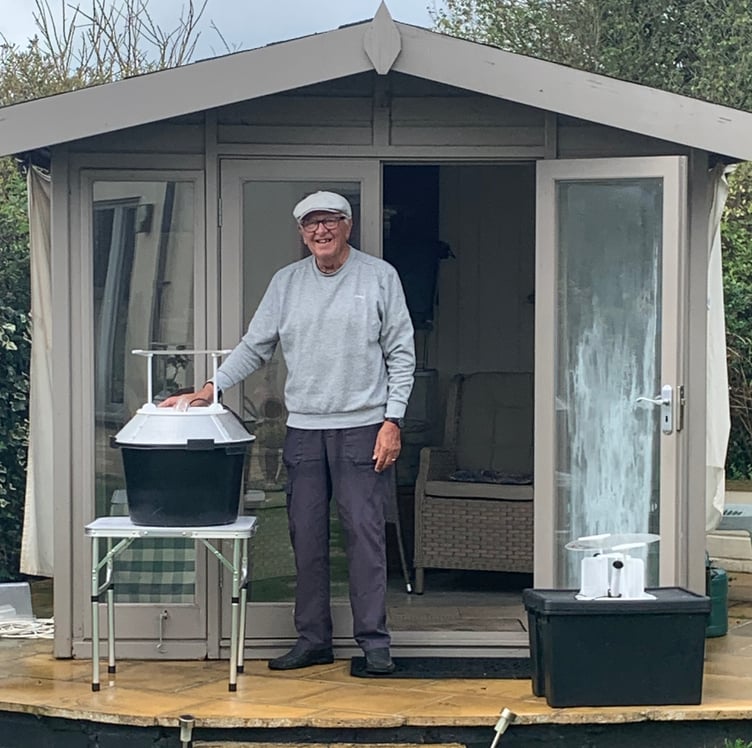
Opening his moth traps each morning is like waking up on Christmas Day for Thurlestone naturalist Michael Passman. He never knows what might be waiting inside, and 2026 has delivered visitors from across Europe and Africa. Jon Gripton meets the man documenting the secret nightlife of the South Hams.
Most people would not choose to begin their day by examining hundreds of insects in a shed.
For Michael Passman, however, opening his moth traps in the morning brings back the excitement of being a child at Christmas.
“You just didn’t know what present Santa Claus was going to bring you,” he said. “When you come downstairs in the morning and open the traps, you never know what might have flown in.”
Michael has spent most of his life watching birds. But when the Covid lockdown restricted how far he could travel, he began looking more closely at the wildlife arriving in his own Thurlestone garden.
So he bought his first moth trap, and an interest quickly became something approaching an obsession.
“It’s probably the only thing I do now, according to my wife,” he joked.
Moth equipment can range from a relatively modest trap costing about £65 to professional models priced at several hundred pounds. A light attracts the moths overnight and directs them into a container where they settle, usually among egg boxes. They can then be identified, photographed and recorded before being released unharmed.
On a busy morning, the process can take Michael many hours.
The results vary dramatically from one night to another. Moths are highly sensitive to the weather: warm, still and cloudy conditions tend to produce the best catches, while wind can keep numbers down. One evening recently, Michael checked his traps at about 10pm and found only six moths. By the following morning, there were 91.



On another exceptional night this year, more than 900 arrived.
The popular image of the moth as a small and rather uninteresting brown insect is quickly dispelled by Michael’s photographs. Britain is home to around 2,500 moth species, many bearing intricate patterns and colours to rival any butterfly.
Some fly only at particular times of year. A relatively quiet winter is followed by the first spring species, before the main season builds towards summer. Then there are the migrants: fragile-looking insects capable of reaching Britain on weather systems originating hundreds or even thousands of miles away.
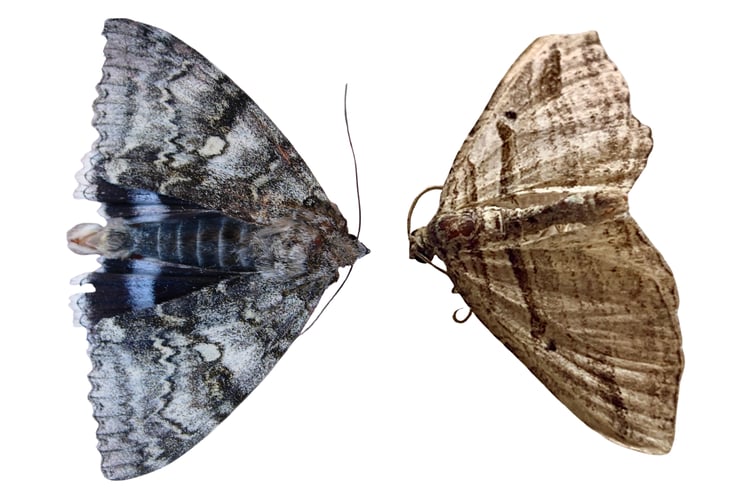
Among Michael’s recent discoveries was a Clifden Nonpareil, one of Britain’s largest and most spectacular moths. Also known as the blue underwing, it hides vivid bands of blue beneath more subdued grey forewings.
The species was once regarded as extinct as a breeding moth in Britain. It has returned in increasing numbers and is now breeding in parts of southern England, although migrants also arrive from continental Europe.
Another notable visitor to Michael’s trap was a ‘Many-lined’ moth. Once a British breeding species, it disappeared in the 19th century and is now encountered here principally as a rare migrant from Europe. Michael said it was the first recorded in Devon for around 15 years.
Thurlestone is particularly well positioned for such arrivals. Moths can be carried north by warm air currents from southern Europe and North Africa, making the South Devon coast one of the first potential landfalls.
And it has been an exceptional year for migrant moths in south Devon. Heavy rainfall in parts of North Africa encouraged the growth of the plants on which their caterpillars feed. That helped produce large populations which were subsequently assisted northwards by warm conditions and favourable southerly winds.
From May 21 to 31 alone, Michael’s Thurlestone records included 842 migrant moths representing 24 species.
Yet the apparent abundance in his traps should not be mistaken for evidence that all is well.
Michael remembers a time when long car journeys after dark would leave windscreens covered with insects. That is now a much rarer experience. Research has recorded a substantial long-term decline in Britain’s moth population, driven by factors including habitat loss, pesticides, climate change and artificial light.
This year’s spectacular migrant arrivals are an exception within that more troubling picture.
Michael has also noticed a pronounced reduction in the number of birds breeding around Thurlestone this year. That is especially concerning because moths and their caterpillars are an essential food source for many species.
His own interest in wildlife began decades before he became Thurlestone’s unofficial moth recorder.
Originally from Middlesbrough, he moved to Birmingham in 1970 and built a successful independent insurance brokerage. But the South Hams had long held an attraction for him.
A keen sailor, he regularly visited Salcombe and later bought a cottage in the area. After retiring, he and his wife settled permanently in Thurlestone to enjoy its peace, seclusion and proximity to some of the area’s most valuable wildlife habitats.
His garden is close to Thurlestone Marsh, allowing wetland species to find their way to his lights as well as moths from the surrounding gardens, farmland and coast.
Michael’s records now form part of a much longer chronicle of the area’s wildlife. Since 2003 he has documented 271 bird species across his Thurlestone patch through his Thurlestone Bay Birds website. His moth observations add another layer to that portrait of a changing natural environment.
He also shares his discoveries with the wider community through the Village Voice publication, although moths present a particular difficulty for his articles. Their delicate colours and detailed markings do not translate in black and white. To appreciate why Michael is so captivated by moths, they really need to be seen in colour.
There is, however, something infectious about his enthusiasm even without the photographs.
Every evening the trap lights are switched on. Every morning brings another small act of discovery. Most catches will contain familiar local species. Occasionally, among them, will be an insect carried across seas and continents by weather systems invisible to the people sleeping nearby.
Then Michael Passman gets to experience Christmas morning all over again.
Comments
This article has no comments yet. Be the first to leave a comment.