
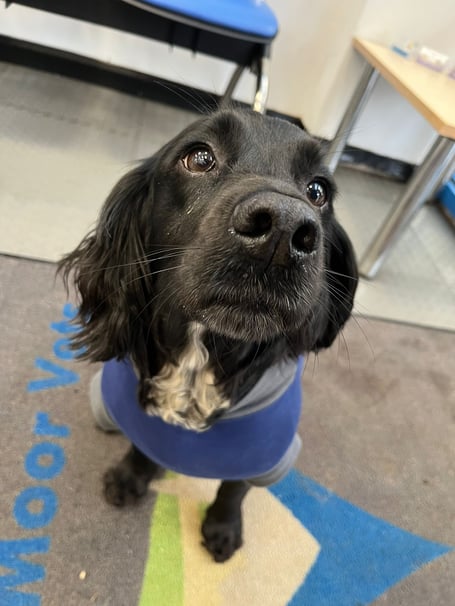
Poor Connie the Sprocker had just been into South Moor Vets for her annual vaccinations before she went charging over a barbed wire fence and ripped the skin off her tummy, taking with it a couple of nipples.
Wounds are not uncommon in any species that we see as vets, but spaniels and greyhounds/whippets are probably over-represented due to their love of scouting around in the undergrowth (spaniels) and their thin skin (hounds).
Connie came straight back into the practice, understandably in some shock, with a large flap of skin hanging from her abdominal wall. She had a huge wound measuring about 15x25 cm on her tummy.
We admitted her immediately, stabilising her on intravenous fluids, pain relief and antibiotics, before contemplating surgery. This stabilization is important to make the subsequent general anaesthetic safer and smoother.

Within a couple of hours Connie was stable enough to be anaesthetised for surgery. Large wounds can be difficult to close, and it is very important that skin is not closed under tension, as this can lead to a wound breaking down.
In Connie’s case, the wound was cleaned and flushed extensively, a flap of skin removed (this was too narrow to incorporate back into the wound as it wouldn’t have had a blood supply), and the wound edges freshened up ready for closure.
Layers of subcutaneous (under the skin) sutures were placed which helped to reduce ‘dead space’ and bring the skin edges close together.
‘Dead space’ is usually where something has been removed, leaving a space behind under the skin, which can then fill with tissue fluid, which stops it healing. We were then able to place skin sutures, bringing the wound edges nicely together, with no tension.
Sometimes wounds require advanced techniques in order to close them without tension, such as using flaps of skin from adjacent or even separate areas of the body. These aim to protect the blood supply to the wound as well as prevent tension.
This may especially be required where a cancerous mass has been removed requiring ‘clean’ margins, leaving large wound deficits. We also sometimes have to place drains in wounds where there is a lot of ‘dead space’ in order to prevent fluid build-up and a seroma forming.
Connie went home later the same day, and a few weeks later, apart from slightly wonky nipples, you would not know that she had been in any trouble!
South Moor Vets is a proudly independent veterinary practice - meaning they are locally owned and not tied to corporate rules or targets - so they work closely with clients to prioritise each pet’s care above all else.
Their experienced team provide high clinical standards, 24/7 care and continuity with the same friendly faces at every visit.
Comments
We've recently changed our login process. If you have an account for commenting, you will need to re-register on the login window.
This article has no comments yet. Be the first to leave a comment.