
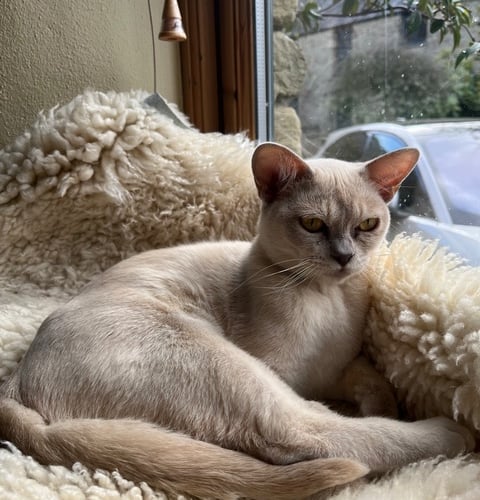
Maya is a beautiful Burmese kitten. Her owners had noticed that she was quite a bit smaller than her brother, and she also had intermittently soft stools. However, when she was 8 months old, she suddenly became very lethargic and had terrible diarrhoea. Her owners brought her into us at South Moor Vets: She appeared quite unwell, pale and weak, with a slightly distended abdomen and a high temperature. We ran some blood tests in our lab. This is a really useful tool we have available, as we are able measure many different parameters and usually have results within an hour, thus guiding our treatment.



Maya’s blood results showed a number of abnormalities. We also performed an abdominal ultrasound scan – this is a similar piece of kit to that used to scan pregnant women and allows us to image the chest (including heart) and abdomen of our patients. Maya was found to have a large volume of fluid in her abdomen. A sample of this was drawn off with a needle and examined under the microscope, revealing lots of inflammatory cells.
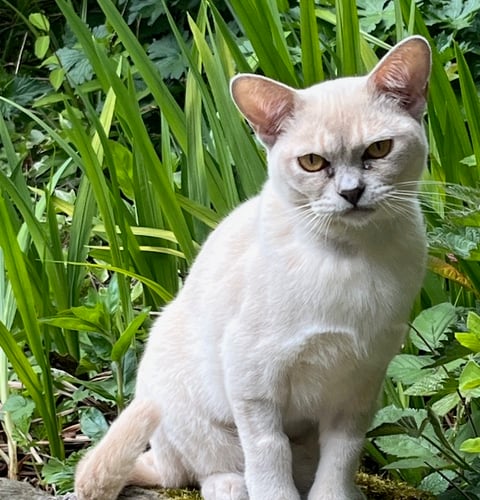
These investigations pointed heavily towards Maya having a disease known as feline infectious peritonitis, or FIP. This is a very serious disease caused by feline coronavirus. Most strains of feline coronavirus cause, at most, diarrhoea for a few days. It is thought that 25% of pet cats have been exposed to coronavirus, but this increases to 80-100% in multiple cat households. Some cats go on to develop FIP due to a mutation in the virus which means that it attacks the cat's immune system and blood vessels. These cats initially become lethargic, lose their appetite and have a fever, but go on to develop either wet/effusive FIP or dry/non-effusive FIP. With wet FIP blood vessels become damaged and leak fluid, leading to build up of fluid in body cavities such as the abdomen (as in Maya's case). Fluid can also build up on the chest and these cats can also develop liver failure. Traditionally this was a rapidly fatal disease. Dry FIP occurs when the immune system slows down but does not stop replication of the virus: This leads to chronic inflammation of blood vessels in the organs such as the eyes or brain and is a more protracted disease.
We sent off samples to an external veterinary laboratory for confirmation, but with results still pending, we started Maya on emergency treatment to help stabilise her.
Until recently, FIP was considered a non-treatable disease and was usually fatal. However, in recent years the development of modern antivirals including remdesivir and GS-441524 now mean that this is a curable disease. Treatment is typically given for 6 to 12 weeks with blood samples throughout to check that therapeutic levels of the drug are reached. Because Maya was very unwell when presented, we opted to refer her for immediate treatment with injectable remdesivir for 48 hours. She then returned home on oral GS-441524 tablets and has been doing very well ever since and we hope to take her off the tablets after 6 weeks of treatment.
Comments
We've recently changed our login process. If you have an account for commenting, you will need to re-register on the login window.
This article has no comments yet. Be the first to leave a comment.