
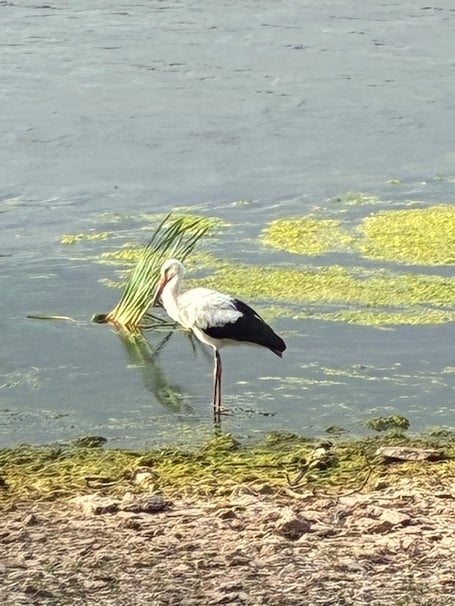
Early one morning towards the end of August we spotted two of our neighbours walking past our house, obviously returning from a walk by the Ley with their dogs. A few minutes later an email arrived from Julia containing excellent photographs of a stork standing by the Ley at the water’s edge. I had heard a couple of days previously that a stork had been sighted by the Bridge but had decided that I would be lucky to spot it. I presumed, wrongly, that it was probably the same bird I had seen on the Kingsbridge Estuary the previous year - a stray bird from Knepp, where Isabella Tree has established a colony. However, Julia’s photograph showed the bird to be in an area where I thought I would be sure to see it, so I set off almost immediately. On my way to the Ley, I was joined by two more neighbours on the same quest, but of the bird there was no sign. After a while they both gave up, but I persisted and walked along the Line to a position from where I knew I would have quite a clear view of the whole of Ireland Bay. Still no stork.
As I walked back home on the Nature Trail, I met Jeff from Devon Birds, who had also failed to see it that morning. He was told that it had been chased off by an unleashed dog and had flown at height into the surrounding fields. However, he said that he had seen it the previous evening and had been able to read the rings on its leg. To his surprise, it was not a bird from Knepp but from a group released a few days before at Bodmin. Coincidentally, the following day, there was an article in one of the national newspapers about the release of 21 birds, freed in the the hope that they would return from their migration to breed in the place of their first outward flight. Storks were native to England until they were shot and eaten to distinction, and I certainly hope all goes well, but I’m not sure what will happen with a captive bird that naturally migrates in the winter. The birds breeding in Germany and Poland fly south over the Straits of Gibraltar into Morocco, not Slapton.
My fruitless search for the stork immediately reminded of past fruitless searches for birds and other wildlife. How easy it often all seems on the television, when, the reality is that they have been hunting for weeks. Some of these fruitless searches, however, can be as memorable as the successful ones. One that immediately comes to mind occurred in Trinidad. We have spent several holidays in Tobago, but this particular year we took a one-day bird spotting trip to Trinidad, involving an early flight out and a late flight back. A small group of us from Tobago met up with a few others waiting with the guide at Trinidad Airport. We immediately set off in a small bus for a wildlife centre located in rain forest high in the hills. As we climbed, we were able to observe black hawks soaring above the canopy below. Arriving at the lodge, we followed the guide on foot down into the rain forest until we reached a wide clearing surrounded by large trees. We spread out and stood in complete silence, waiting patiently for the calls of the bell birds that we all hoped to see. It was very quiet for a rain forest, and I started to hear the pattering of raindrops, soon followed by torrential rain. We tried to shelter under the trees to no avail and were forced to retreat. Once back in the Lodge, many immediately raided the souvenir shop to buy something dry to wear. No bell birds for us. Nightfall found us all in small boats in the mango swamps, watching thousands of scarlet ibis come in to roost. Was this more or less memorable than the first?
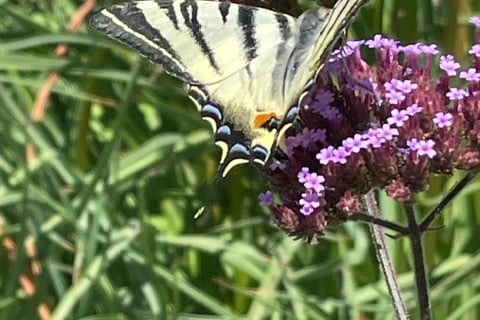
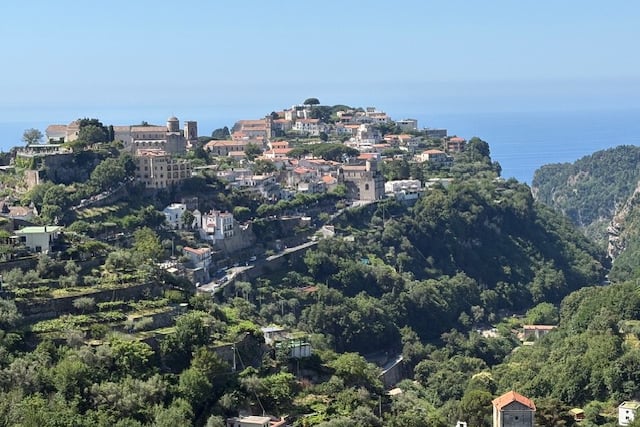
We visit Italy nearly every year in late Spring or early Summer. This year we went once more to our favourite destination, Ravello - the walled city high above Amalfi with distant views across the bay to Salerno - to visit the fine gardens and walk the mountain paths once more. It was still quite cool when we arrived, but this did not stop the gardens of the Villas Cimbrone and Rufolo being filled with the high-pitched calls of tiny Serins hidden in the evergreens and the sight of many swallow-tailed butterflies flitting from flower to flower. There were probably more swallow tails than we have ever seen before. Swifts and the much browner Pallid screamed across the front of our hotel balcony and the sky was filled with house martins. Every day a kestrel was to be seen working its way through the trees below us.
After a few days, with air temperatures now rising, we descended from the city through its rear gate, headed along the narrow lanes and then made a steep climb to where the mountain paths begin. As usual we paused to look back at Ravello perched on its hilltop, before heading along the ancient track past the goat enclosures and into the forest, with the River Dragone flowing far below. We were expecting a path alive with butterflies. Yes, there were plenty of Italian Marble Whites, but no short-tailed blues or festoons. Over recent years a great deal of effort has been made to clear the ancient tracks, making the network of footpaths more accessible, but this has led to the loss of many of the flowers that used to grow along the track itself. Has this led to a loss of butterfly numbers? Or is it just that we have been visiting earlier to avoid the high temperatures?



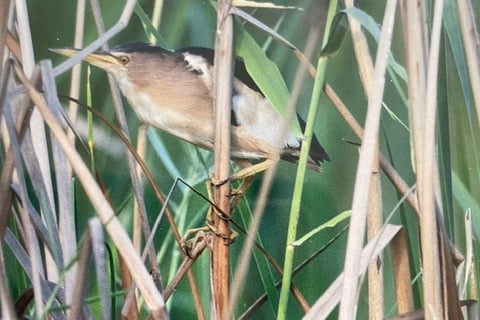
We perched on a wall and looked down into the river valley. A Jay and then a Hoopoe flew in front of the trees below us. I decided to run the Merlin song identifier, not expecting anything exciting, and it started to pick up the common species, then suddenly a Little Bittern. My first reaction was to dismiss it, but then I realised that the river and its reeds below us, and in southern Italy, was just the spot. Of course, the chance of seeing the bird even if we took the track down to the river was negligible. Another miss. I hadn’t even heard it call.
Comments
This article has no comments yet. Be the first to leave a comment.