
Help! My pond’s getting out of hand!
These weren’t quite the words that Kate used in her email to me but I was certainly rallied into action at her message, excited at the prospect of seeing the garden pond which I had helped to design and create in the latter part of 2020.
After the lockdowns and isolation in the early months of that year, I had been delighted to be invited into Kate and Geoff’s beautiful sheltered garden in one of our prettiest coastal villages to discuss her special birthday wish: the creation of a wildlife pond.
After agreeing the design, layout and planting scheme, I worked with James Montague to turn Kate’s dream into a reality. James carried out all the digging by hand - a necessity, given that garden access is through the cottage itself! After the liner had been installed and the pond filled, I had the most exciting job of creating a variety of wildlife habitat features and planting up the baskets with native aquatic and bog plants, then arranging them within the pond. My final act was to present Kate with a small pot of ramshorn snails carefully harvested from my own pond and for her to release them into their new home. It was a very satisfying project and I was thrilled at how much joy and anticipation it had kindled in Kate.
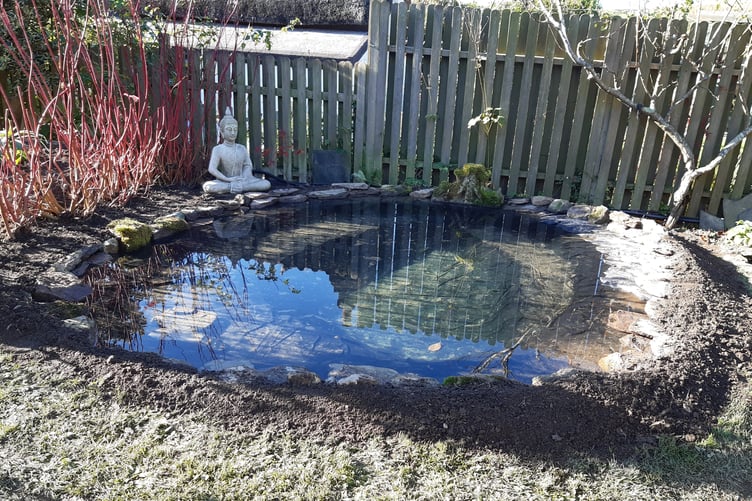
I did pop back a couple of times after it was completed, the second time around a year later. The pond looked much more natural: the planting had established well, and it had been both colonised and visited by a wide variety of wildlife: newts, frogs, toads, dragonflies, whirligig beetles and many other invertebrates. Birds came to drink and bathe, and as for the ramshorn snails, these were now numerous, visible below the water’s surface, grazing on algae and other plants.
So, another five years on, what would it be like? I gathered my waders, net, pond gloves, tools and buckets and headed over to find out.
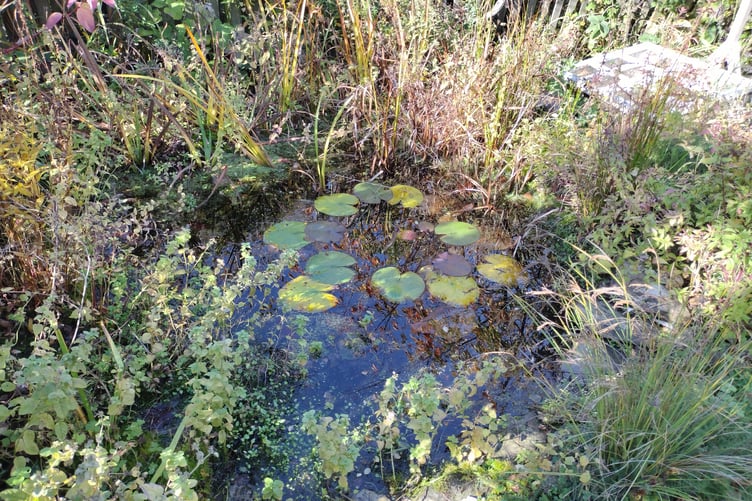
Kate greeted me enthusiastically and led me through the house into the sunny garden where Geoff was busy with some autumn maintenance. We went down together and surveyed the scene. At first sight, I was surprised as I had remembered the pond as being bigger but it soon became apparent that several of the plant species had spread a long way into the pond leaving only a small circle of open water in which Kate’s water lily took pride of place. I was going to have to get in and do some thinning out.
An important question to ask is: is there an ideal time of year to carry out management in a garden pond? Answer: no, as different plants and animals have different cycles of growth, reproduction and (potentially) dormancy. In this case, I was happy that I could make a difference with minimal disruption as the majority of adult newts would have already left the pond and the juveniles would be able to move to safety. In the South Hams we predominantly find palmate newts; the protected species, great crested newt, has not (yet) been recorded here.



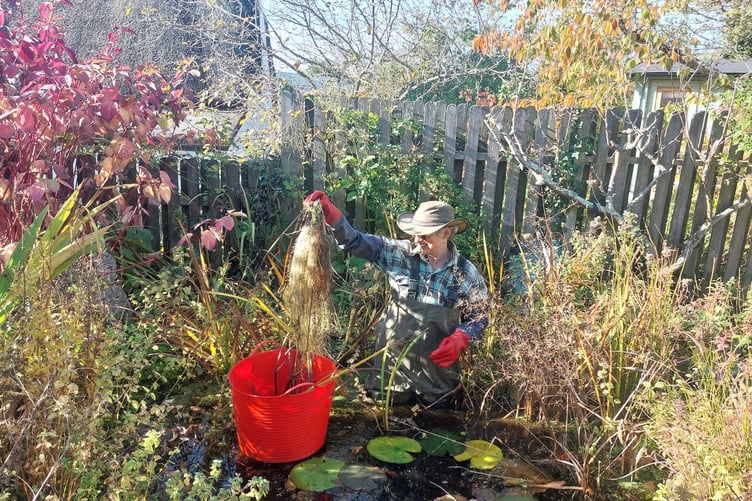
Donning my chest waders, I carefully slid into the pond, being mindful to keep my movements slow and avoid moving my feet too much. Any encroaching rooted plants, mainly sedge, bur-reed and water mint, I eased out gently and rinsed off the roots before placing them in my big red, floating
bucket. When it was full, I pushed it over to Geoff and Kate to double check for creatures and then transfer to the compost heap. Nothing would be wasted!
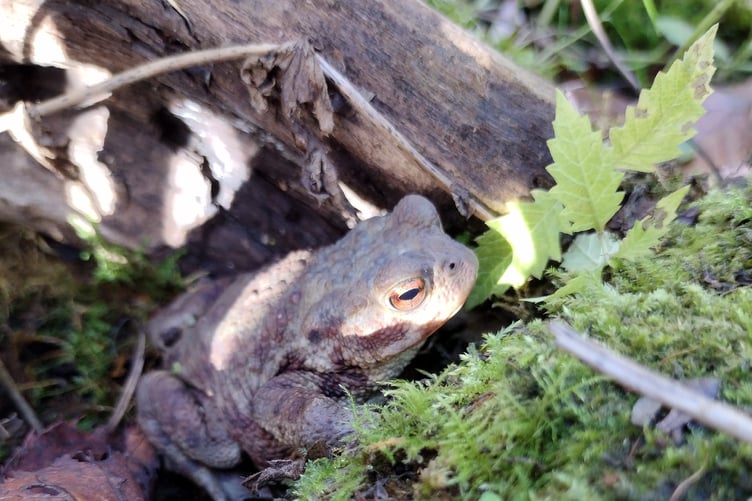
Geoff had already discovered a large bronze-eyed toad squatting under a log on the bank side, then Kate pointed out a frog in the water, looking up at me beside one of the lily pads. Then, as I fished out a clump of duckweed (which Kate suspected had been introduced on the feet of visiting pigeons), we spotted movement in the net. At first I assumed it was a newt but after parting the vegetation, a glistening brown dragonfly larva was revealed - another of the pond’s top predators.
Back on dry land and de-wadered, I encouraged Kate to visit Devon Wildlife’s Trust’s website and look for more ideas in their Wildlife Garden Award scheme checklist (https://www.devonwildlifetrust.org/wildlife-garden-award); also, to visit the excellent Freshwater Habitats Trust website (https://freshwaterhabitats.org.uk/) where there is expert advice on every aspect of pond creation and management.
It had been a most enjoyable way to while away time in the autumn sunshine, especially given Kate’s unbound enthusiasm and curiosity, keen to learn all she could about the small aquatic universe in her garden which her dream had brought into being.
Comments
We've recently changed our login process. If you have an account for commenting, you will need to re-register on the login window.
This article has no comments yet. Be the first to leave a comment.