
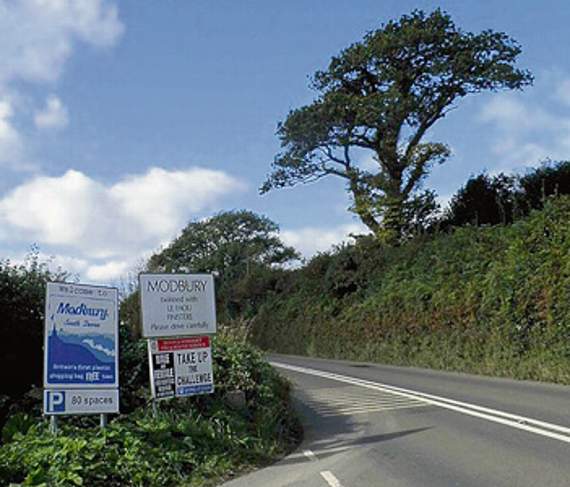
THIS week has seen England take a leaf out of Modbury’s book, as shoppers across England face a compulsory charge for carrier bags.
From Monday, October 5, the law requires all large shops in England to charge 5p for a single-use plastic carrier bag. The aim is to reduce their use and the litter they cause by encouraging people to reuse bags.
The war against plastic bags began in 2007, when Modbury became the first town in Europe to ban the bags from all the shops in the town.
The idea was suggested by local wildlife camerawoman Rebecca Hosking, who had visited the Pacific to film marine life for the BBC, but was shocked by the horrendous plastic bag pollution she saw in the ocean.



Rebecca told The Guardian in 2007: ‘It really affected me. I’ve never cried behind a camera before. I’m not a blubby person, but it broke my heart to see animals entangled in plastic, albatrosses dying in plastic, dolphins trailing plastic and seals with their noses trapped in parcel-tape roll.
‘The sea is now like a trash can and the plastic is there forever. It doesn’t go away for hundreds of years. What I witnessed was just so unnecessary. All this damage is simply caused by our throwaway living.’
On her return to Modbury, she held a public screening of the film at the town’s Brownston Gallery to show the impact on the marine environment. At the end of the film all the traders agreed to stop handing out plastic bags. Miss Hosking was made an MBE for her initiative in 2009.
In a report shown on BBC Spotlight on Monday, biologist Dr Pennie Lindeque from Plymouth Marine Laboratory explained that around 300 million tonnes of plastic is produced every year, with around 10 per cent of it ending up in our marine environment. Plastic takes many years to break down, eventually ending up as micro-plastics.
Dr Lindeque’s research has focused on the effect that micro-plastics have on zooplankton when it consumes it. This contamination could be passing up the food chain to humans after tiny pieces of plastic were found inside the guts of the microscopic creatures.
Eight years after the ban, locals and visitors to Modbury have grown accustomed to bringing a reusable bag with them when shopping.
Gill Watts from Pickles hardware store said: ‘It’s not difficult. Some holidaymakers and people from urban areas look at you funny when you explain the ban, but we explain that you either pay for a biodegradable bag or use one of your own.’
Graham Wildman, a partner of the Brownston Gallery, believes the new law doesn’t go far enough.
‘Why haven’t other towns and villages followed Modbury’s lead?’ he said. ‘If people are being charged 5p, they should be given a choice whether they want a biodegradable one. If the Co-op in Modbury can do it, why can’t other supermarkets?
‘Why are we going down the route of selling plastic bags? This might reduce the number of plastic bags, but it won’t solve the problem.’
Manager of the St Luke’s Hospice charity shop Jane Brown said: ‘It’s never been difficult, but a seamless passage. If it hadn’t been for the Co-op, which distributed a Modbury cloth bag to every household in town, it would have been a lot harder.
‘I have very mixed feelings about the new charge. I don’t want plastic bags at all, but I think it would be too much of a lifestyle change for the whole country.
‘We should look at all the plastic we use, from bags to cellophane wrapping, and how it impacts on the environment.
‘It would be great if individual villages and small towns could follow Modbury’s example and totally ban plastic bags. It’s amazing how quickly people adapt, even visitors.’
Comments
This article has no comments yet. Be the first to leave a comment.