
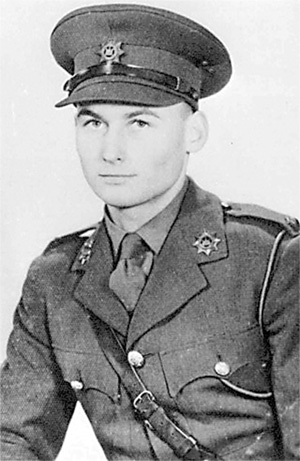
FORMER Dart Vale and South Pool Harriers rider David Mylchreest is to receive the Légion d'Honneur for his part in the liberation of France during the Second World War. Mr Mylchreest, who now lives in Normandy, was a young Second Lieutenant when he became the first British officer to cross the river Seine. Now David is sharing his experiences with French schoolchildren as part of the project '70 voix de la liberté' – 70 voices of freedom – which aims for 70 testimonies to be collected by 70 youth centres. He told a school class: 'When I am asked how many German soldiers I have killed, I prefer to say how many I saved'. Talking about his contribution to '70 voix de la liberté', he said: 'When I see WWII cemeteries filled with young people, I say to myself that war is a terrible thing. 'Young people should know that peace is not easily acquired.' His father served in the First World War . He was a vicar in Buckfastleigh, before moving to Bowcombe with his wife and daughter Patience when he retired. David Mylchreest volunteered for service at the age of 17 in 1941 but, due to his youth, he was sent for two years military training in a battalion in Exeter. He was finally enlisted in 1943 and was made second lieutenant that year. Landing on the beach at Arromanches six days after D-Day, his team made their first contact with Nazi forces at Maltot, south of Caen, in early July. Their hardest fight was at Côte 112 on July 10-11, a small hill 10k south west of Caen that had significant strategic importance. The 8th Corp, including David's 43rd Wessex Division, ran into opposition from the German 1st SS division and it took more than a month to finally gain control, despite the British army having the upper hand with superior firepower. David said the artillery battle was as ferocious as those of the First World War. Over 500 men in his regiment were killed or wounded and they fired 43,000 shells at the German army. Between August 1 and 7, 1944, David continued fighting in the bocage and took Mount Pinçon. On August 12 and 13, they arrived in the Falaise-Chambois Pocket. Field Marshal Mont-gomery, ordered the division to march to Vernon, Eure, with 23,000 vehicles and to rebuild a bridge over the Seine .



For the full story, see this week's Kingsbridge and Salcombe Gazette
Comments
This article has no comments yet. Be the first to leave a comment.