

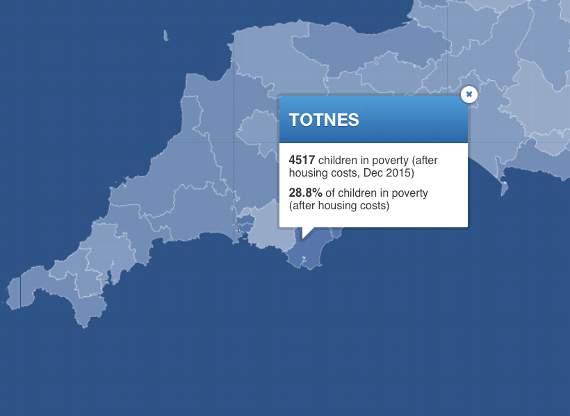
FIGURES released by the charity End Child Poverty show that more than a quarter of children in Kingsbridge are living in poverty.
The figures, calculated by The Centre for Research in Social Policy, break down the estimated levels of child poverty before and after housing costs in each of the wards in the South Hams.
They show Kingsbridge East as having 22.87 per cent of children in poverty before housing costs and 34.5 per cent after. Kingsbridge North has 15.34 per cent before, and 24.03 after. Rates in the same area after housing costs include Allington and Loddiswell - 26 per cent, Charterlands - 10 per cent, Salcombe and Malborough - 26 per cent, Saltstone - 23 per cent, Stokenham - 20 per cent, Thurlestone - 32 per cent and Westville and Alvington - 19 per cent.
‘Poverty’ is taken as 60 per cent or less of the median household income in the UK, which is £23,556 with two adults. So this is a household income of less than £14,133.



The Living Wage Foundation has set the Living Wage - the wage needed to live in the UK outside of London - at £8.45 an hour, or £17,576 a year. Two adults earning the Living Wage would have a household income of £35,152 a year.
District and Country Councillor Julian Brazil said: ‘These figures seem extraordinarily high, but this is a symptom of our low wage economy in the South Hams, paired with house prices that are so expensive. Poverty is an emotive word and I hope that children in this area have a good quality of life, we have great schools and outside areas.
‘This is a result of our unbalanced society and we have to to do something about it.’
District and County Councillor Rufus Gilbert responded to the figures, saying: ‘I find myself quite shocked by these figures, although somewhat sceptical as to how these figures are compiled. I have to say that the children I see going to school or in the parks and shops don’t seem too badly off. Although I’m sure, some parents are finding times very challenging indeed and I’m personally very concerned for those families.’
Nationally, 3.5 million children are currently living in poverty in the UK, with the density being as high as 47 per cent in some areas, particularly large urban centres.
Sam Royston, chair of the End Child Poverty Coalition, said: ‘As the Prime Minister has rightly recognised, this is not a country that works for everyone. In every community, there are children being denied the happy childhoods and the good start in life other children take for granted. Our children are twice as likely to be poor as our pensioners.
‘Families who are just about managing today, won’t be managing tomorrow if Universal Credit leaves them with fewer pounds in their pocket and if inflation means the pounds in their pocket don’t stretch as far as they used to.
‘This month’s Autumn Statement is a major opportunity for the new government to act to help these families. We urge the Chancellor to reverse the significant cuts to Universal Credit targeted at working families and, at the very least, shield children’s benefits from inflation.’
Dr Sarah Wollaston MP said: ‘These figures set out the scale to which high housing costs in the South Hams impact on disposable incomes for local families. This is an area which I have raised with the housing minister Gavin Barwell MP and I have invited him to visit to hear directly from campaigners on affordable housing. ‘Solutions that work for inner cities will be different to those for rural areas where land values make it so difficult to build genuinely affordable housing. I was glad to hear the announcement in the budget on affordable housing but would like to see funding available for affordable housing in rural communities. ‘It is also interesting that the courts have upheld the changes brought in by St Ives to try to control the levels of second home ownership through a principle residency requirement. It will be interesting to see if other neighbourhood plans adopt this approach but this is for local people to decide.’
You can see all of the facts, figures, calculations and the interactive map on the End Child Poverty website: www.endchildpoverty.org.uk/poverty-in-your-area-2016/
Comments
This article has no comments yet. Be the first to leave a comment.