

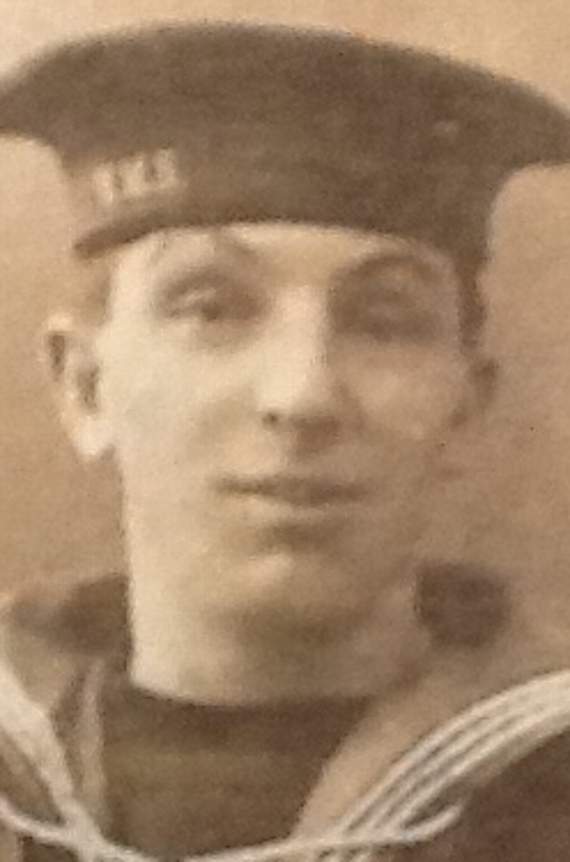
Those men who made the ultimate sacrifice in the largest naval battle of the First World War will be remembered in ceremonies next week.
The Battle of Jutland on the afternoon of May 31, 1916, cost the lives of over 8,000 men.
Among them were two Kingswear men – Richard Todd and Frederick Brewster – who were on the same ship and whose names are on the church war memorial.
A special reading will take place in the parish church of St Thomas of Canterbury on Sunday to mark the centenary of the 36-hour battle off the coast of Jutland in Denmark.



The Imperial War Museums is also asking members of the public to discover, remember and share the stories of the men who bravely lived, fought and died, on a permanent digital memorial, Lives of the First World War.
Both sides claimed victory in the battle. However while the Germans lost 11 ships in comparison to the 14 ships lost by the British fleet, after the battle Britain managed to put as many as 24 dreadnoughts to sea, whereas the Germans only had 10 ships fit to fight.
Consequently the German surface fleet failed to significantly challenge the British again during the war.
One of those killed in action that day, Richard Todd, was the great uncle of Mark Setters, who was brought up in Brixham.
Mr Setters moved away 30 years ago but now has a house in Kingswear.
The other Kingswear resident named on the memorial who died at the same battle was Frederick Brewster.
His reading will be given by historian Tessa Gibson, a relative of Mr Setters, who was born and bred in Kingswear and lives in Brixham.
Richard Charles Giles Todd joined up to serve his country in 1912, six days after his 18th birthday.
By joining the Royal Navy he was following in the footsteps of his grandfather, Richard Bufton.
He died at the age of 21. His body was never recovered and his remains lie somewhere at the bottom of the North Sea as part of an official war grave site.
Richard was a stoker first class on the battle cruiser HMS Indefatigable.
Between 4pm and 4.05pm on May 31, 1916, while engaged in combat, the battle cruiser was hit by 28cm shells from the German cruiser Von der Tann.
One of these hit a turret, causing the magazine to explode, which sent a chain reaction through the ship. There was a second explosion that was so massive it hurled pieces of the ship 200ft in the air. The ship, effectively ripped apart, sank immediately with its crew of 1,019 sailors, leaving only two survivors.
Mr Setters said: ‘Richard was down below, deep in the heart of the ship doing everything at 100 miles an hour, with the adrenaline and fear running through his body.
‘The crew knew it needed every single one of the 1,000 crew to give a bit more effort to make a difference to the ship.It really wasn’t about the guys firing the guns who decided the outcome on these massive ships.
‘The admiral of the fleet made a special point of this in his report after the battle, heaping praise on the engine room sailors.
‘While the battle was going on they would know nothing about how things were going up top.The noise of its own 26 guns would have deafening plus the huge engines screaming at maximum power. They would definitely know when they got hit though,even above the noise, and it must have filled them with dread.
‘They got hit three times, the fourth one caused the massive explosion. I hope Richard knew nothing about it, rather than being trapped and drowned as the ship went down. The reason the ship sunk so quickly was the first explosions literally blew out the hull and so its likely he was caught in those explosions.’
His name is recorded on a wall plaque in Kingswear church for those who died from the village during the First World War.
His name is also recorded on the Plymouth Naval Memorial.
‘Though his life was tragically short, this local Kingswear boy took his part in world changing events and deserves to be remembered,’ added Mr Setters.
Another sailor serving with Richard was Frederick Charles Brewster.
Tessa Gibson said it would be nice to find some surviving relatives of the second Kingswear war hero.
‘Frederick Brewster also lost his life at Jutland,’ she said. ‘His father Alfred Brewster was a butler, although we do not know at which Kingswear house he worked.
‘He arrived in Kingswear from Harrow, Middlesex, with his family in the summer of 1895 and took one of the Agra Villas on Brixham Road.
‘Frederick Charles Brewster, who was a scholar at Kingswear School and left in 1898 having reached Standard VI, the highest achievement possible in the school. In 1901 the family were living at 3 Overhill; Frederick had one elder brother and four younger sisters.
‘The eldest son Alfred served in the Navy and then joined Robert Falcon Scott’s team to go to the Antarctic leaving on the Discovery, but he left the ship early because he did not like it on a sailing ship.
‘Frederick C Brewster, aged 16, was apprenticed to a mason. He joined the navy and his intelligence and work bore fruit.
‘Frederick was a Petty Officer Stoker it is likely he and Richard Todd would have been on duty together that fateful day.
‘The Commonwealth War Graves Commission records that Petty Officer Frederick Charles Brewster RN on the cruiser HMS Indefatigable, was killed in action at the battle of Jutland on May 31, 1916.
‘Two of the Brewster sister lived in Bankhouse, Lower Contour Road, until their passing in the 1980s, breaking along connection with the village.’
Imperial War Museum historian Paul Cornish said: ‘The Battle of Jutland was the greatest naval engagement of the First World War and the only battle ever to be fought between rival fleets of Dreadnought battleships. By 1916, the Royal Navy’s blockade of Germany – which cut off almost all seaborne trade – was causing food and raw material shortages. The German High Seas Fleet was eager to break the blockade, but was outnumbered by the British Grand Fleet at Jutland. Germany claimed the battle as a victory, but the British maintained mastery of the North Sea and Germans were doomed to suffer the blockade until the Treaty of Versailles in 1919.’
Dan Snow, naval historian and TV broadcaster said: ‘Jutland is one of the greatest sea battles of all time. It decisively affected the outcome of the First World War and thus the course of the 20th century.’
Do you have a relative who fought in the Battle of Jutland? You can help complete the stories by uploading photos, linking to evidence and adding stories sharing First World War connections on http//:www.livesofthefirstworldwar.org.
Comments
This article has no comments yet. Be the first to leave a comment.