
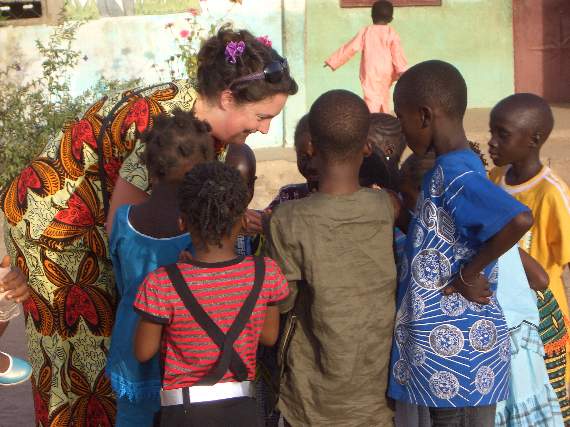
A CHARITY transforming the lives of hundreds of people in a tiny African country continues to operate with the minimum of fuss thanks to the tireless work and unceasing generosity of the people of South Brent.
The unexpected link between Brent and Bakary Sambouya, a village of a similar size in the Gambia, began 14 years ago when an appeal went out to support a teacher’s salary in a school there.
Brent resident Sue Currant had a small plot of land on which she grew Christmas trees and that year, she decided to put the proceeds towards the school. She also arranged a collection of materials at South Brent Primary School, and after a teacher said it would be nice for pupils to see the faces of the children when everything arrived, Sue decided to travel to the Gambia to see them for herself.
She recalls: ’What I found was a school of 30 or 40 children in this village. They only had benches to sit on, no equipment, and a deflated football to play with. The teacher had no training, and would get the children to recite numbers and the alphabet - learning by rote.

’When I got home I asked a group of friends if they could help me raise some money to buy more to equip the school. And it went from there really, to where we are now, with people making regular donations.’
By focusing on one village the Kambeng Trust has achieved an astonishing amount for a charity with not a single UK employee. As well as the school, which has been completely transformed, the trust also took on responsibility for a clinic that had been started by a Cameroonian woman living in London.
The move doubled the charity’s outgoings overnight.
The trust was also responsible for funding and providing a community bus in 2005, used by women in Bakary Sambouya to take produce to market and allowing them to sell much more. It also took emergencies to hospital, women to anti and postnatal clinics, served the needs of the school, and was available for general community use.
The Trust has replaced these lifeline vehicles as they have aged, and recently sent its fourth vehicle over to the Gambia, packed full of donations from Brent, and supplies for the school and clinic. Locals in the African village have now started running the bus commercially, a development that means the trust no longer needs to fund its upkeep.
Villagers even managed to save £2,000 - a phenomenal amount in a country where the average annual income is just £200 - towards the cost of the latest vehicle. This has given villagers an important sense of ’ownership’, Sue says, something the trust tries to promote through its work.
The Kambeng Trust has also started training, mostly local women in the art of beekeeping, giving them honey and wax products to sell at market. The techniques used are slightly different to our UK beekeepers, and Sue pointed out most of the work has to be done at night as the fearsome African bees are so vicious during daylight hours.
The trust believes sustainable development projects like this are vital for the future of Bakary Sambouya and its people. It has also worked to support the creation of a communal garden for villagers and a vegetable garden for the school, and improve water supply and sanitation by replacing wells and toilets .
The Kambeng Trust also keeps a reserve fund for dealing with emergencies, like when wet season storms regularly destroy homes and other buildings. At times they have launched specific appeals in South Brent to deal with such emergencies, and also receive money from other charities like Festival Medical Services to support their work.
Sue said: ’We’re gradually transitioning the clinic to be more sustainable. Everything is done by our project manager there, who works with the committees and villagers. I am in contact with him most days.
’The main aim is sustainability. We don’t go in saying ’this is better than the way you do it’, we work with the management committees and help them find finance. We provided training for the committees earlier this year on how to take on a management role. They are the employers of all the staff.
’Potentially, the clinic can almost be self-funding. There is a charge for consultations and medicine in line with a government clinic.
’We’ve started to do the same with the school, but it’s very difficult because lots of people can’t afford it. The government doesn’t fund nursery education at the moment, although we know they are beginning to see the value of it. So it’s a balance of trying to make it self-sustaining without excluding anyone.
’In government schools there are lots of things they have to pay for, like the uniform and books, and there is even a charge for taking exams. This excludes a lot of children. We provide a mid day meal, and that is a big incentive for people to send their kids to school - there are now about 200 pupils.’
Sue gave one particular example of the value of the trust’s work. She explained: ’A five year old twin girl who lives in the village now, fell into a bowl of hot food when she was three and sustained severe burns to both hands. There is no specialist burn treatment in Gambia, and as she grew, because of the scar tissue her hands became completely deformed and useless.
’We found a Norwegian plastic surgeon working in Ethiopia who agreed to treat her for free, to restore the use of her hands. We funded his travel to come to Gambia, to operate on her and other child burns victims, and he also did some teaching in the hospital and medical school.
’The child’s injuries are so extreme that she needs a series of operations, so in September this year we sent her with her father to Ethiopia for the remainder of the treatment. She is part way through it now, and already has full use of her right hand again.
’It’s hoped that by February she will return home to a normal life with both hands fully functioning.’
Sue paid tribute to the continuing support the trust receives from the people of South Brent, and said this year’s Christmas tree sale alone raised more than £1,500. She said: ’People locally support us. Not everyone knows about what we do, but there are a core of people who are incredibly supportive and incredibly generous.
’Bakary Sambouya is going through an interesting transition at the moment. It’s bisected by the main route running north and south to Senegal, which until recently was a dirt road that was impassable at times.
’It was tarmaced a few years ago, and that has brought major changes. There’s now a very straight, very fast road going through the village. It brings more trade, but also more development, and I think the village will eventually join up with Brikama, the town about four miles away.
’It’s still the dream of every young person to take what they call ’the back route’ - across the Sahara and onto the refugee boats to Europe. However hard you try and tell them that what they find there may not be the life they expect, it’s still the dream.
’It’s very very sad. There’s nothing you can say to persuade people that it’s maybe not such a great idea.’
For more information on the work of the Kambeng Trust, visit www.kambengtrust.org.uk .
Comments
This article has no comments yet. Be the first to leave a comment.