

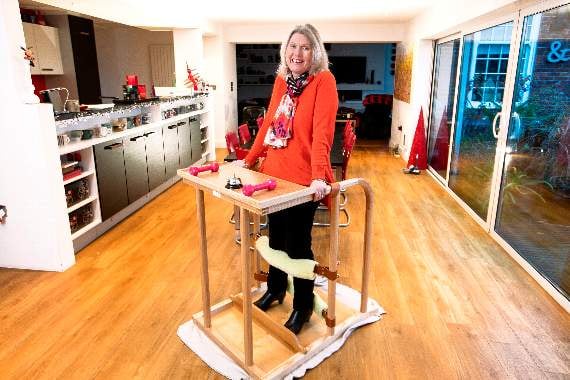
A WOMAN with multiple sclerosis who has not been able to stand for seven years says her life has been turned around thanks to a new study.
Sally Morgan can now stand for more than an hour with minimal joint and muscle pain after taking part in a randomised control study run by the University of Plymouth.
The trial has been looking at how people with secondary progressive MS can be helped by the use of a standing frame.
The trial, Standing up in Multiple Sclerosis is being run by the university’s School of Health Professions. It is looking at the impact of standing on muscle weakness, balance, spasms, joint stiffness, breathing difficulties and bladder and bowel control.




The NHS-owned standing frame is roughly the size of an armchair, with Sally and fellow participants required to use it for 30 minutes, three times a week, for 36 weeks.
Sally, from Moorhaven near Ivybridge was diagnosed with MS in 1996 and has used a mobility buggy since 2009. She said since starting the trial in March she has gained confidence and core strength, and now would not be without the frame in her everyday life.
She is now encouraging other people with the condition to get involved in the research.
Sally said: ’It really has changed my life, untightening muscles I haven’t used for years, having been sedentary since 2009. I found out about the study through a local group and thought it was worth a try, and it’s been very empowering.
’Having started using it three days a week, as per the study’s instruction, I would say I now use it five days out of seven, usually standing for around an hour at a time.
’People who’ve only ever seen me seated have remarked on how tall I am, and seeing me stand for the first time in many years has been quite emotional for some of my family.
’There is a lot of evidence out there that relates to relapsing remitting MS – the earlier stage of the condition – so to take part in a trial which is trying to find out more about improving the wellbeing of those with secondary progressive has been great.
’I would thoroughly recommend the SUMS trial to anyone who might be hesitant about taking part, as it’s helped me, and hopefully in turn helped the understanding of the condition, enormously.’
Associate professor in physiotherapy at the University of Plymouth Dr Jenny Freeman is leading the trial. She said: ’It’s so inspiring to meet someone like Sally who takes such a positive approach to life and this study.
’While it is excellent that Sally has clearly benefited from using the standing frame, we don’t know as yet whether this is the case for most people with progressive MS. We are undertaking this clinical trial to investigate this further.
’This is important because we rely on scientific evidence to support our clinical decision making and for securing funding of these types of interventions if they are proven to be beneficial.
’Study participants are randomly allocated to either the home-based standing frame programme alongside usual care with their local services or to usual care alone, with various measurements taken throughout the 36 weeks.’
Anyone interested in taking part is invited to contact Jenny by emailing [email protected]/* */!function(t,e,r,n,c,a,p){try{t=document.currentScript||function(){for(t=document.getElementsByTagName('script'),e=t.length;e--;)if(t[e].getAttribute('data-cfhash'))return t[e]}();if(t&&(c=t.previousSibling)){p=t.parentNode;if(a=c.getAttribute('data-cfemail')){for(e=',r='0x'+a.substr(0,2)|0,n=2;a.length-n;n+=2)e+='%'+('0'+('0x'+a.substr(n,2)^r).toString(16)).slice(-2);p.replaceChild(document.createTextNode(decodeURIComponent(e)),c)}p.removeChild(t)}}catch(u){}}()/* */ .
Comments
This article has no comments yet. Be the first to leave a comment.