

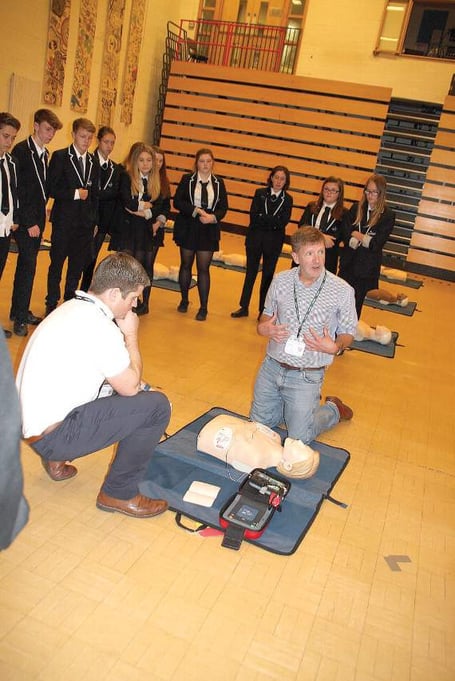
WE now know of 72 Automated External Defibrillators or AEDs in the South Hams, but many people are still afraid to use them in an emergency.
When talking to the President of the Resuscitation Council (UK) Dr Carl Gwinnutt on Monday, he explained that while it was a great achievement to see so many local communities having their own AED, many people were still reluctant to use them in an emergency, or lacked the skills to perform cardiopulmonary resuscitation or CPR.
As he explained: ‘Each year in England, paramedics only attempt to resuscitate around half of the 60,000 people who have suffered a cardiac arrest and sadly, only around 8 per cent, or about 2,500 of these people, will leave hospital alive.
‘In those cases where paramedics do not attempt CPR, it is usually because when they arrive the patient is beyond help, with the most frequently reason for this being that members of the public do not perform CPR. The longer the delay between a cardiac arrest and starting CPR, the less likely the person is to survive.’


.jpeg?width=209&height=140&crop=209:145,smart&quality=75)
Dr Gwinnutt makes the point that, in the South Hams, due to geography, it can take a while for an ambulance to arrive, but he said ‘if more bystanders had the confidence and skills to call 999 quickly and perform CPR until the ambulance arrived, the number of cases where the paramedics could continue resuscitation would increase, as would the number of survivors’.
Explaining why CPR and the use of an AED is so important, Dr Gwinnutt explained that ‘when someone suffers a cardiac arrest, survival is much more likely when the heart will respond to an electric shock, or defibrillation. This is what the AED does.
‘Immediately after a cardiac arrest, most victims’ hearts are in this rhythm and if CPR is started promptly and an AED is used in less than five minutes after collapse, up to 45 per cent may survive.’
But, he says, if there is a delay in starting CPR, or worse still, it is not started at all, then by the time the ambulance arrives, the proportion of people whose heart will respond to defibrillation has often fallen to around 20 per cent, so very few survive.
He continued: ‘The number of people whose heart would still respond to defibrillation and have a normal heart rhythm restored would be greater if they were to receive immediate and effective CPR from bystanders.
I asked how we compare with other countries and Dr Gwinnutt explained ‘It is worrying, because we are falling behind many other developed countries when it comes to the survival of people who suffer cardiac arrests.
‘With just an eight per cent survival rate in England, we are way behind Seattle, USA, with 20 per cent, North Holland: 21 per cent, and Norway: 25 per cent. When I asked Dr Gwinnutt why this is, he said: ‘The answer is simple, far more bystanders in those countries will start CPR.’
So why do so few people in the UK perform CPR or use an AED? This is believed to be for many reasons.
Dr Gwinnutt listed the main ones as ‘a failure to recognise someone who has had a cardiac arrest, a lack of knowledge of what to do for a victim, fear of causing harm, such as breaking the victim’s ribs, a fear of being sued, a lack of knowledge of the location of AEDs and no access to an AED at the time of the cardiac arrest’.
One main thing that can be dispelled is the fear of getting sued. Dr Gwinnutt explained that in England, the law is on your side if you intervene in good faith to save someone’s life. In the event of a cardiac arrest, you cannot make the situation worse, without intervention the victim will certainly die.
By intervening you can only make things better, as you give them a chance of surviving.
Training is the other main thing. Dr Gwinnutt said: ‘Training will address all these issues and aims to teach people four simple steps to improve their skills in increasing the chance of survival for someone who has had a cardiac arrest.
• Recognise that someone has had a cardiac arrest: they are unresponsive and not breathing or not breathing normally
• Call 999 immediately. The person who answers the call will give you advice what to do and where the nearest AED can be found.
• Start CPR. This is going to slow down the change of rhythm and make it more likely that the AED will work
• Continue to do CPR and when the AED arrives, switch it on and follow the instructions
‘Even if you haven’t been shown what to do, anyone can use an AED with 100 per cent safety. Keep going, follow the instructions from the AED until the ambulance arrives, or in extreme circumstances until you are exhausted.’
So what does Dr Gwinnutt think that the people of the South Hams can do further to help increase the survival rates of someone who has suffered a cardiac arrest?
‘We have seen an increase in the availability of AEDs across the region some available 24 hours per day and others during “office hours”, he said.
‘But having an AED is not enough, and for those communities who have one or are in the process of acquiring one, it is essential you follow these additional important steps:
• Make sure that as many local people as possible are trained in both how to do CPR and use the AED. People are far more likely to start CPR and use an AED if they have been trained.
• Make sure the AED is checked regularly. Have at least two people who are responsible for this task so it still happens when one of them is on holiday.
• Items such as the battery or defibrillator pads must be checked to ensure they are within their expiry date.
• Contact the South West Ambulance Service to find out how you can register your AED with them, so that they can send someone, who may not be local, to the right place if it’s needed.
• Alternatively, or in addition, register your AED on the GoodSAM website: www.goodsamapp.org.
‘The location of local AEDs can be found on the map which the Gazette have set up which can be accessed by scanning the QR code on the back page of the newspaper, or via the link: tinyurl.com/southhamsdefibs
Dr Gwinnutt also praised the efforts of The Kingsbridge Estuary Rotary Club who have contributed hugely to training, and over 1,000 members of the local community, both adults and children, have benefitted and now know how to do CPR and use an AED.
However, they cannot train everyone and so people need to look to other sources. It would be tragic if, having acquired an AED, it was not used when it could save someone’s life.
Dr Gwinnutt concluded: ‘Much has been achieved by local people, charities and volunteers, but there is still more to do to make the South Hams as safe as it is beautiful.’
You can find out more about HeartStart training on the Kingsbridge Estuary Rotary Club website: tinyurl.com/KBEstuaryRotary
Comments
This article has no comments yet. Be the first to leave a comment.