
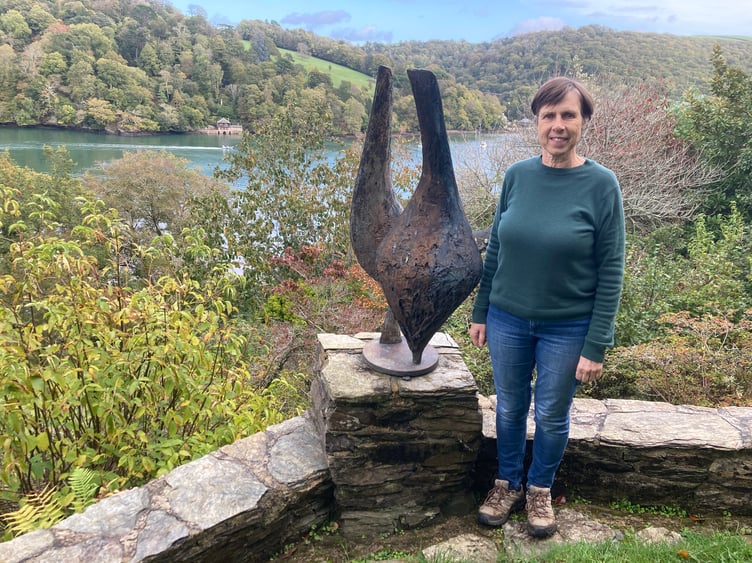
Dittisham-based sculptor Bridget McCrum RWA FRBS, whose artistry captured the movement and lightness of birds in stone and bronze, has died aged 92.
Bridget, who died on October 18, developed an interest in art from an early age. Among her earliest works is a small sculpture of a dog she made as a child.
Her daughter Sarah recalls that Bridget’s childhood was shaped in part by evacuation from London to Exmouth during the Second World War.
Among the children Bridget lived with was Elizabeth Frink, who would go on to become one of Britain’s most celebrated sculptors.
“There were about seven children living there with a wonderful woman who looked after them for quite a few years,” Sarah said.
“One of the older girls who was in that group turned out later to be a very famous sculptor called Elizabeth Frink. My mum and Elizabeth used to draw and do art together during all that time.”
Bridget went on to study fine art, developing an appreciation for the shapes and spaces between objects.
“She always spoke about seeing the shapes between things and she learned that from her art teacher,” Sarah said.
At 21, Bridget married Robert, a young naval officer also known as Bobby.
His career took the couple around the world, and they had three daughters.



It was only after her youngest daughter had finished school that Bridget returned to sculpting.
“She was quite shy in many ways, and while she was travelling somewhere my dad entered a little piece of her sculpture into the Scottish Academy Art Competition and it was accepted,” Sarah said. “That’s what really started to build her confidence.”
Bridget subsequently sought out stonemason John Joekes, from whom she learned the craft of carving stone.
She later spent time in the Middle East and undertook archaeological expeditions in Somalia and elsewhere, producing drawings during months spent in the desert.
The couple also bought a house on Gozo, the Mediterranean island - its soft sandstone, easily carved by hand, offered a different perspective to what she has previously experienced.
“The fishermen there carve out their huts out of the stone – you can get a spoon and just carve, it’s so soft – and it creates these beautiful sculptural shapes,” Sarah said.
Bridget and Robert finally settled in Dittisham around 44 years ago. Robert had studied at Dartmouth College, and the couple were drawn back to Devon.
“My dad grew up in Belstone on Dartmoor so they wanted to come somewhere, and they found this beautiful place,” Sarah said.
There, their interests came together in the garden of their home. What had been little more than grass and six pine trees became, through Robert’s gardening and Bridget’s sculpture, became a lovingly crafted landscape.
One of Bridget’s sculptures, a bronze piece, Millennial Birds, stands beside the road leading down to the Ham in Dittisham.
For Sarah, her mother’s work was distinguished by its ability to convey delicacy and life through materials more commonly associated with weight and permanence.
“It’s the search for the essence, especially of birds, of movement, of lightness in a very heavy material, which is stone and bronze,” she said.
“The other thing is that her work is alive, which for such heavy materials is I think also something very special.”
Bridget’s work can be viewed at bridgetmccrumb.com
Comments
We've recently changed our login process. If you have an account for commenting, you will need to re-register on the login window.
This article has no comments yet. Be the first to leave a comment.