

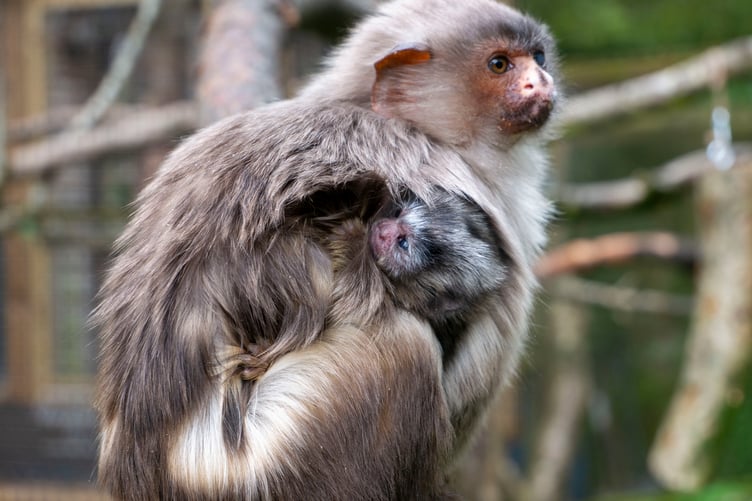
Edwina and Ernie, Dartmoor Zoo’s Black-Tailed Marmoset breeding pair, have become parents for a second time following the arrival of a new infant on Sunday, June 28.
The pair are one of only two Black-Tailed Marmoset breeding pairs in European zoos and have been together since July 2025. Their first offspring, Echo, was born on Tuesday, December 2, 2025, and the family has now grown again with the latest arrival.
The newborn, which has not yet been sexed or named, is being closely cared for within the zoo’s marmoset family group and is already being described by staff as an important ambassador for its species.
Dartmoor Zoo chief executive David Gibson said each birth of the species carries particular significance due to its global rarity in captivity.




He said: “Celebrating the birth of any animal within the zoo is always a pleasure, but when there are less than 30 individuals of that species known to be held in zoos globally every single new addition is extra special. We are absolutely delighted to welcome this latest addition to the Dartmoor Zoo family as we continue our efforts to help preserve this important species.”
The Black-Tailed Marmoset, or Mico melanurus, is considered Near Threatened on the IUCN Red List and is native to parts of central South America, including Brazil, Bolivia and northern Paraguay. It is the southernmost member of the Mico genus and the only species in its group with most of its range outside the Amazon rainforest.
The species is small, measuring between 18 and 28cm in length and weighing around 300 to 400g. It is dark brown in colour with a distinctive black tail, which gives the species its name, along with a paler underside and a white or yellow-white stripe running down the thigh. Its ears are hairless and flesh-coloured, standing out from its coat.
In the wild, Black-Tailed Marmosets are diurnal and arboreal, using claw-like nails to move through trees. They live in small social groups, communicating through scent marking and vocalisations, and are known to defend territory using calls and facial expressions.
Their diet mainly consists of tree sap, although they will also eat fruit, insects, bird eggs and small vertebrates. Females typically give birth after a gestation period of around 145 days, usually to twins, with fathers and wider group members helping to raise the young.
Head keeper Jenna Crawford said the latest birth had been a welcome moment for the animal care team.
She said: “We’re unbelievably pleased at yet another birth within our tiniest primate family. Working with the Black-Tailed Marmosets has been a continual supply of invaluable joy. I can’t wait to watch their firstborn, Echo, step into big sister mode.”
Dartmoor Zoo said the new arrival highlights the importance of conservation breeding programmes for rare primates, particularly those facing threats such as habitat loss, deforestation, agricultural expansion and the illegal pet trade.
Visitors are being encouraged to see the growing family for themselves.
Comments
We've recently changed our login process. If you have an account for commenting, you will need to re-register on the login window.
This article has no comments yet. Be the first to leave a comment.