

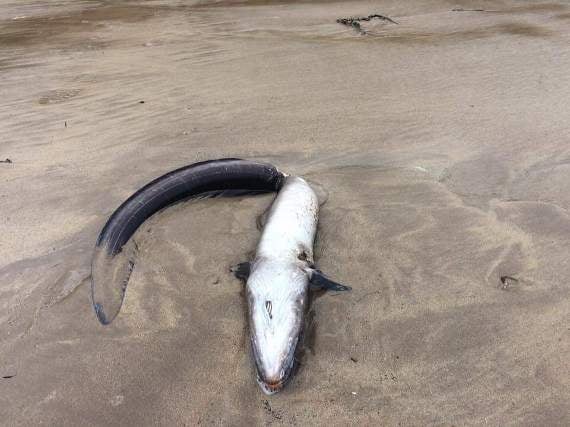
A TWO foot long Conger eel washed up on Hope Cove beach on Sunday, giving a slightly prehistoric look to the beach.
Kingsbridge resident Mike Trembath was on the beach with his family when he saw the eel and took some photos.
Peter Rendle of The Marine Biological Association in Plymouth has identified it as a European conger eel, latin name Conger conger, and explained that the biggest threat to adult conger eels is us - humans.
Conger eels are the largest eels in the world and are native to the northeast Atlantic and the Mediterranean Sea. They can reach up to three metres in length - about ten feet - have very sharp teeth and strong jaws, and prefer to be near rough ground such as a reef or wreck.



Conger eels are thought to only spawn once and then they die, so any eel caught will be a juvenile that hasn’t yet spawned.
The problem with removing species from the ocean before they have spawned is that they haven’t been able to secure the next generation. The more fish we take from the ocean before they spawn, the faster the population of that species plummets.
This is why there are legal restrictions on the size of the fish that can be caught, to prevent juveniles being removed before they have had a chance to breed.
A fascinating thing to see on one of our local beaches.
Comments
This article has no comments yet. Be the first to leave a comment.