
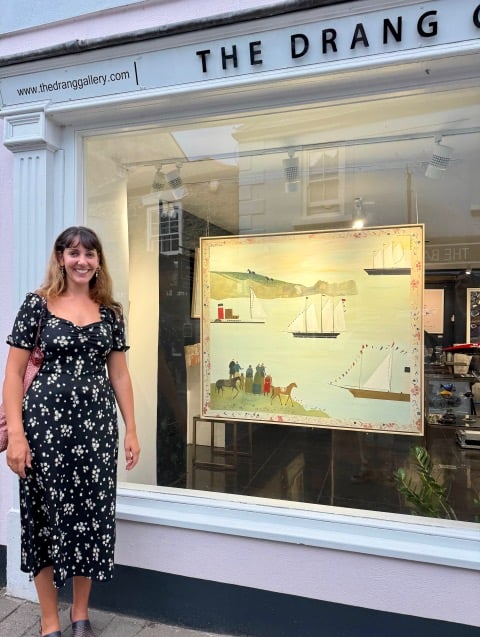
There is something deliberately elusive about Holly Razavi’s paintings.
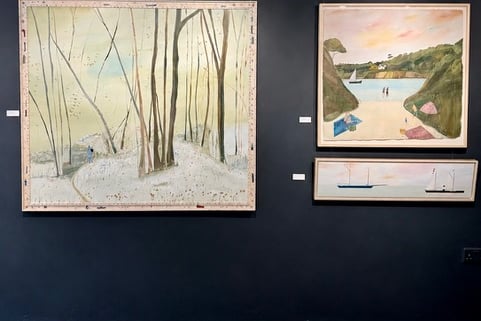
At first glance, the places are familiar: a beach, a harbour, a hillside, a boat cutting across the water. But look again, and the details begin to slip away. The colours are softened, the figures are simplified, and the landscapes seem to hover somewhere between a remembered place and a dream.
For Razavi, a Kingsbridge-based artist, painting is not about faithfully reproducing what is in front of her. She takes photographs on her travels and adventures, but does not use them as references when she paints.
Instead, she paints from the feeling those places have left behind.
The result is a body of work that feels recognisable without being overly literal – landscapes which could belong to South Devon, Cornwall or almost anywhere else where land meets sea.
That quality is at the heart of Razavi’s first solo exhibition at The Drang Gallery in Salcombe, launched alongside this year’s Salcombe Regatta Week.
The gallery describes her work as having a “beautiful dreamlike quality”, while adding that her local scenes are particularly captivating.
Gallery manager Marc Murray said the paintings had been “flying off the walls”.
“They’re beautiful. They capture the essence of the area and what I like about them is that they could be anywhere in Devon; they’re about how you connect with the imagery,” he said.
Her restrained approach to colour helps create this distinctive atmosphere. Razavi works with a deliberately limited palette, while her oil paintings use simplified forms and gentle marks.


Razavi is self-taught, although her artistic journey has taken her through different places, influences and experiments.
Her earlier work developed through an interest in artists she loved, while her own visual language has continued to change.
She has exhibited in group and solo shows in Britain and internationally, including exhibitions in Canada, London and Cornwall.
Her relationship with the coast is particularly important. Having experienced periods when life felt chaotic, Razavi became increasingly interested in stillness and calm – qualities that now permeate her work.
There is also a sense of movement in the paintings: people walking, boats travelling, swimmers in the water. Yet nothing appears hurried. Even when the subject is recognisably a busy coastal scene, Razavi seems to slow it down.
That contradiction gives the work much of its charm.
For an artist nervous about taking the next step, the response to the exhibition has provided a considerable confidence boost. Razavi has spoken about how supportive the gallery environment has been, and about the pleasure of seeing people engage with the work she has spent so long developing.
Razavi’s paintings do not demand that the viewer identify precisely where they are. They are paintings of places, but ultimately they are paintings about memory and the strangely powerful way a landscape can stay with us long after we have left it.
Comments
This article has no comments yet. Be the first to leave a comment.