
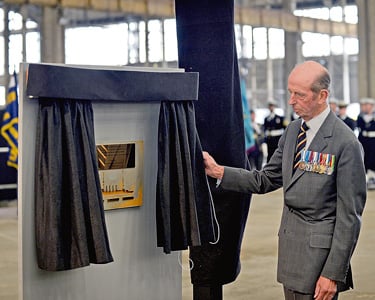
THE lives of 13 cadets from Dartmouth's Britannia Royal Naval College lost in the early days of the First World War have been commemorated during a special service held
at Chatham Historic Dockyard.
A group of 15 cadets was mobilised to join HM ships Aboukir, Hogue and Cressy.
The ships were sunk by a German U-boat off the Dutch coast on September 22, 1914: a total of 1,459 sailors were lost on that tragic day, including the 13 cadets.


Among them was Midshipman Herbert Lawson Riley. A plaque in his memory hangs in the chapel at BRNC. It reads: 'In loving memory of Midshipman HL Riley RN. Grandson of Sir John Lawson Bart. He gave up his life in the North Sea while trying to save the life of another when his ship HMS Aboukir was torpedoed in action, September 22, 1914, age 15 years.'
Guest of honour at the service was His Royal Highness the Duke of Kent, who unveiled a plaque commemorating the loss of the three cruisers.
He was joined by First Sea Lord Admiral George Zambellas, the Lord Lieutenant of Kent, senior Royal Navy and military offic-
ers, civic dignitaries
from Kent and the Netherlands, members of the Live Bait Squadron Society and guests and families of those who have direct connections with the action of September
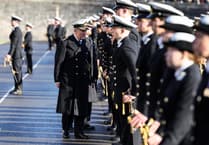
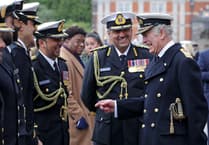
22, 1914. Service Association Standards also took part. Two Royal Navy archer-class patrol vessels – HM ships Smiter and Exploit – were also present, along with a Royal Navy guard and the Band of Her Majesty's Royal Marines Com-mando Training Centre on parade.
BRNC was represented by Dr Richard Porter and Dr Jane Harrold, senior lecturers at the college, who also act as the respective archivist and curators of the Britannia Museum.
HM ships Cressy, Hogue and Aboukir were three old ships of the bacchante class. They were manned predominantly by reservists who had been mobilised in August as part of the war effort and the cadets from BRNC.
Together with their sister ships they were assigned to the 7th Cruiser Squadron. The squadron's main duty was to patrol the North Sea between the English and Dutch coasts. Just seven weeks after war was declared, HM ships Cressy, Hogue and Aboukir were shot at by a German U-boat and sunk.
Of the combined crew of 2,296, there were only 837 survivors, a few hundred of whom were rescued by Dutch merchant vessels. The bodies of British sailors continued to wash ashore on the Dutch coast weeks after the tragedy. Some of them are buried in cemeteries in Holland, including 20 at a cemetery in The Hague, where a Cross of Sacrifice can be found bearing their names.
During the Act
of Remembrance in Chatham, the mayor of Medway handed a poppy wreath to the mayor of The Hague for laying at Dutch commemorations, which were due to be held two days later.
Comments
This article has no comments yet. Be the first to leave a comment.