

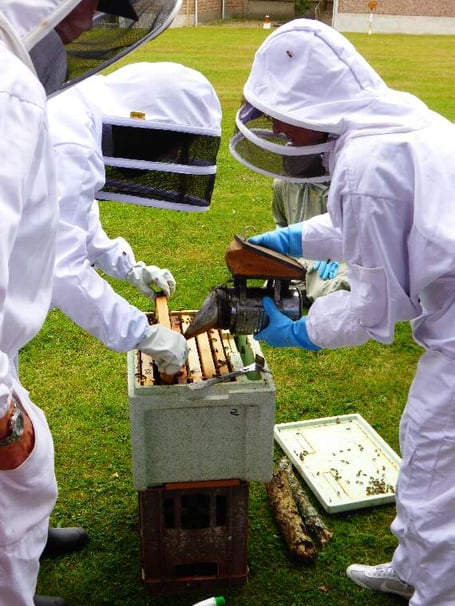
BEEKEEPERS in the South West have reported an almost 50 per cent drop in the amount of honey produced by each colony this year.
This year’s average haul of 16.7 pounds per hive is far below last year’s bumper crop of 29.5lbs in the region.
And the figures mirror a nationwide drop in yields, with Britain’s beekeepers reporting an average of 21lbs per colony this year, against 32lbs last year.
In the British Beekeepers Annual Honey Survey, 1,561 enthusiasts answered questions about their harvest posed by the British Beekeepers Association. Keepers pointed the finger of blame for the drop squarely at the weather - excessively windy and with too few prolonged warm spells.

.jpeg?width=209&height=140&crop=209:145,smart&quality=75)
It was not an ill wind for all beekeepers though: while 50 per cent of beekeepers cited a lower yield than last year, 25 per cent report an increase. And South Brent beekeeper Dick Everett says that the picture locally is similarly bittersweet.
Dick said: ‘It’s always useful to have the statistics - but they should be interpreted in the light of local conditions. In my experience here in South Devon, some beekeepers have done well this year and secured good honey crops while others haven’t.
‘Why? Because of factors not disclosed by figures.
‘Factors like the ready availability of good nectar forage; biodiversity which ensures a range of plants for the bees to choose from; and whether the beekeeper is willing to take his or her bees to a specific crop like oilseed rape, blackberry or heather.
‘Himalayan Balsam can be a real pain in the countryside, but its long and productive season is often a saviour to the honey bee colonies accessing it and can seriously help their development.’
Dick also says generalisations about the weather may mask variation in conditions locally. He continued: ‘I am always fascinated by the impact of the microclimate within which each colony operates. For instance, bees in the sheltered coastal areas of the South Hams tend to consistently do better than those on the elevated and exposed open spaces of Dartmoor, only a few miles distant.
‘For this reason, the beekeeping season of colonies close to the sea can be two to three weeks earlier. This can be very significant in terms of their early development into a foraging force and in turn, their honey crop.
‘At the end of the day, its down to the beekeeper to know his area and manage his bees accordingly. Understanding of the broader picture is vital, so it is really useful to have this authoritative information from the British Beekeepers Association.’
The Association’s Tim Lovett said: ‘Bees stay in the hive if it’s excessively windy and if they’re not out foraging, yields will drop. While confined to the hive the bees of course eat the stores of honey that they have already gathered.
‘Similarly cold, windy weather impedes queen mating, resulting in fewer eggs and ultimately fewer worker bees to collect nectar. There were few calm days recorded during May, June and July – the most important months for foraging, queen mating and brood rearing.
‘It’s fair to say that the summer of 2015 delivered quite simply the wrong weather for our bees.’
Generous funding to support beekeeper training comes from the BBKA’s ‘Adopt a Beehive’ scheme sponsored by Burt’s Bees, which enables members of the public to become ‘armchair beekeepers’ and follow the progress across the year of a local apiary, at a distance, from the comfort of their homes.
Anyone interested in becoming a beekeeper can source information from the BBKA website, bbka.org.uk, or visit adoptabeehive.co.uk to become an ‘armchair beekeeper’.
by Toby Leigh. [email protected] 01548 856353
Comments
This article has no comments yet. Be the first to leave a comment.