

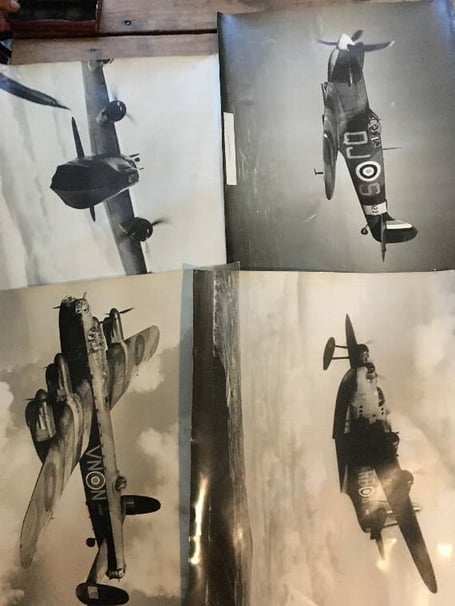
Josephine Prentice was looking into the attic of her terraced home, behind what was the old post office at Churchfields in Dartmouth, and discovered half a dozen large photographs of WW2 aircraft. Each photograph carried two stamps on the back, one of the War Ministry and one giving the name T A Hampton. Knowing Gara Hampton and that he could be found at Alf Resco’s cafe in Dartmouth every morning at around 8am, she took them to show him as, perhaps, T A Hampton could have been related.
Gara said: “These are definitely my father’s, that is his name on the back. He was a test pilot during the war. A shell exploded above the wing of the bomber he was flying and although the plane still managed to fly, my father’s hearing was badly damaged.
“He was unable to hear clearly and could not follow instructions received by radio. He was transferred to test flying where he could fly alone and not need to follow lengthy and numerous instructions from a tower or formation instructions from a squadron leader.
“He was based in Lossiemouth for a time and perhaps these photographs are from there but I can’t tell whether he is flying the planes in the photographs or if he took them. I know he flew Spitfires and Lancasters, amongst many other planes, so they could be of him flying.”


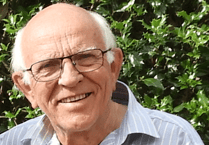
Gara’s father, who died in 2002, was born in Birmingham in 1912. Apprenticed to the Austin Motor Company after leaving school, he was fascinated by motor-cycles but more so by aeroplanes.
While still an apprentice, he raced motorcycles and during his racing career he raced at Donington, Isle of Man, Ulster Grand Prix and the Grand Prix de Europe. By 23, he had designed a motorbike for a now defunct manufacturer, the OK Supreme Company, where he was designer and works manager.
As a teenager, Trevor Hampton, took to the open sea in a collapsible rubber canoe. He arrived in Calais after a hazardous journey around the English coast. He eventually made his way to Barcelona hitch-hiking before taking up work with Supreme.
Trevor lived his twenties married to his teenage bride and mostly afloat between the UK and the continent. As war became all too certain, he joined the RAF and went to elementary flying school at Anstey near Coventry. He excelled going solo in 7 hours 30 minutes and coming top in navigation. Next, he went to the RAF flying school and the advanced school and received his wings in September 1939.
Trevor flew Wellingtons on bombing raids until his poor hearing meant he was restricted to those missions whereby radio communication was not essential. This led to posting as a test pilot, first on Blenheims and Miles Masters but followed by Hurricanes, Ansons, Oxfords, Hudsons, Havocs and a Tomahawk.
During his flying career Trevor flew over ninety types of aircraft, including Lancasters, flying Fortresses, Sunderland Flying Boats and Halifaxes. He was demobbed as a Flight Lieutenant with an Air Force Cross.
Trevor lived and worked in Dartmouth to the end of his days. He and his wife Gwyn, built their own home from a boat shed on Warfleet Creek 65 years ago. He was known as a sailor, expert diver and instructor. Gara and his sister, Gill, continue to live in Dartmouth.
The photographs are now back in the house he built.
Comments
This article has no comments yet. Be the first to leave a comment.